
[Decoding] How are the flows of rivers supplying nuclear power plants managed?
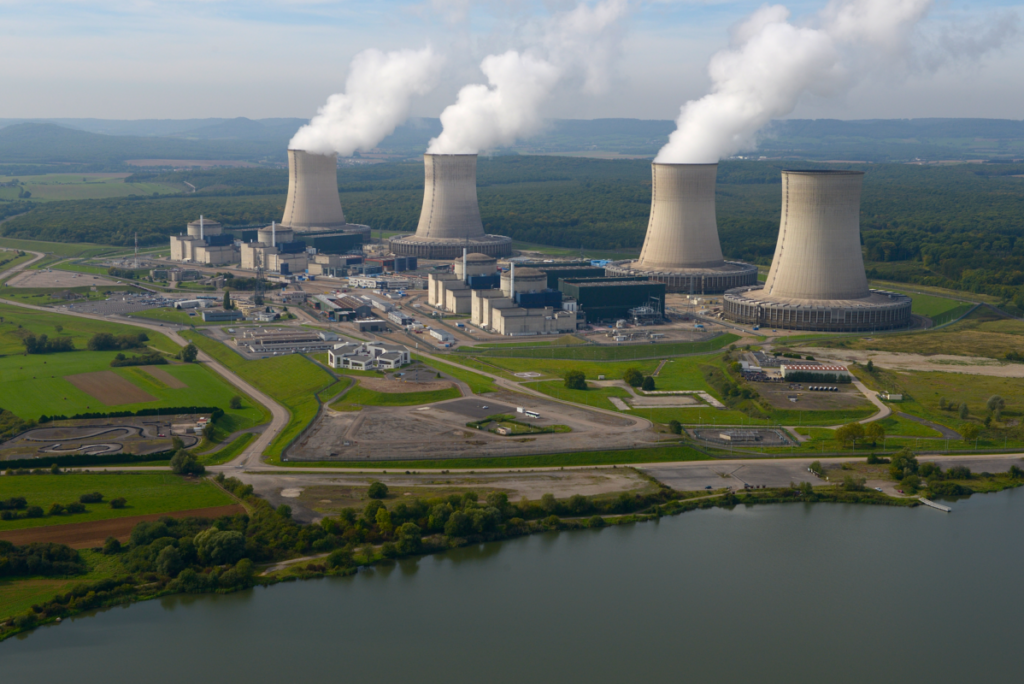
Three nuclear reactors were shut down at Cattenom and Chooz at the beginning of August due to falling river flows at the sites. The event illustrates the different needs and strategies involved in managing this precious resource during periods of extreme heat.
“With an average temperature of 24.9°C, July 2026 was the hottest month ever recorded in France, across all months of the year, since measurements began in 1900,” Météo-France noted in a climate assessment on 4 August. Hungary is not the only country where extreme heat is disrupting the normal operation of nuclear power plants. While such weather conditions usually require some nuclear sites to limit their thermal discharges in order to protect aquatic ecosystems, at Chooz and Cattenom it was the decline in river flows that led to the shutdown of the units.
Chooz: ensuring water sharing with Belgium
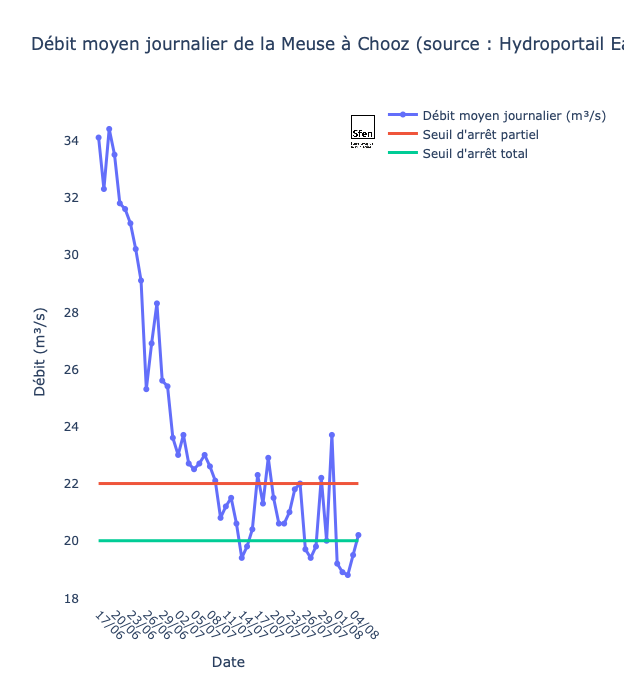
The Chooz nuclear power plant shut down its two reactors, each with a capacity of around 1,450 MW, on 11 July and 1 August respectively, “in order to comply with the Franco-Belgian agreement of 8 September 1998 on the management of the waters of the Meuse,” EDF explained in a statement. The purpose of this cross-border agreement is to preserve water resources for the needs of the neighbouring country, as the river is used in particular for drinking water production, navigation and certain industries.
During normal operation, the nuclear power plant withdraws 2 m³/s from the Meuse per reactor, half of which is returned to the river after cooling. The other half of its water use is released into the atmosphere as steam during the cooling process, resulting in net consumption of around 1 m³/s per reactor during the summer period (slightly less in winter). To limit the impact downstream of the plant, the Franco-Belgian agreement requires one unit to be shut down as soon as the flow of the Meuse falls below 22 m³/s, and both reactors to be shut down when it falls below 20 m³/s. In its statement, EDF specifies that the flow of the Meuse on 2 August was 18.6 m³/s. This situation, moreover, has no impact on the safety of the facility: “only 6.3 m³/s are required to ensure the cooling of our reactors,” the plant’s website states.
The Chooz plant also occupies a unique position in France in terms of water resource management. Among the rivers on which nuclear reactors are located, the Meuse is the only one without a major upstream reservoir capable of supplementing the flow of its water source in the event of severe low-water conditions for all human activities.
All other rivers supplying nuclear reactors are connected to reservoirs and basins that make it possible to maintain minimum flows sufficient for human activities and the environment. As a general rule, these reserves are used to support river flows during low-water periods and are not specific to nuclear activities.
Cattenom: dedicated water compensation
In addition to Chooz, two other plants are exceptions, this time with what is known as a “compensatory” water source: Golfech and Cattenom. For the latter, when the plant was built, EDF decided to create a reservoir large enough to compensate for the Moselle water evaporated by each of the plant’s cooling towers during low-water periods, EDF explains on its website. The Vieux-Pré hydroelectric facility, located in the Vosges mountains, therefore specifically offsets the nuclear power plant’s water consumption through evaporation when the river flow falls below 26 m³/s at the Luxembourg border.
This compensation process is defined in a cross-border agreement with the Grand Duchy of Luxembourg. As at Chooz, each of Cattenom’s four reactors consumes around 0.85 m³/s at full power during the summer period. This water consumption is compensated by Vieux-Pré, which releases the same volumes of water throughout the period during which the flow at the border remains below 26 m³/s.
Ensuring that at least one unit remains in operation
Despite this compensatory facility, and while two other units were undergoing scheduled maintenance, the low flow of the Moselle led to the precautionary shutdown of one reactor at the plant on 31 July, in order to preserve the remaining flow for all other uses in France and Luxembourg, including navigation, drinking water production and, of course, the needs of aquatic ecosystems.
At the same time, the precautionary shutdown of one reactor makes it possible to keep one unit operating at power in a closed cooling circuit using Lake Mirgenbach as its heat sink (a reservoir adjacent to the plant), despite restrictions on withdrawals from the Moselle. With the closure of Fessenheim and the shutdown of the two Chooz reactors, Cattenom is, together with the two reactors at Nogent-sur-Seine, the last nuclear power plant still operating in the Grand Est region. It therefore represents a strategic asset for local power grid management.
Electricity generation remains more than sufficient
Although reactor shutdowns at Cattenom and Chooz due to declining river flows are relatively rare events, they do not pose a challenge to French electricity generation. Contacted by RGN, EDF pointed out that “France continues to export large amounts of electrons to neighbouring countries despite these shutdowns.” For example, according to RTE data, France exported 233.3 GWh of electricity over the course of 5 August, equivalent to around 17% of total electricity generation that day.
In addition, power modulation and generation shutdowns may be necessary during the summer period in order to comply with regulations on thermal discharges and protect aquatic ecosystems. It should also be recalled that pressures on security of supply in France are concentrated in winter. Low electricity demand in summer, even with the growing use of air conditioning, makes it possible to carry out work at power plants that is less critical than during the cold season. ■
By Simon Philippe, Sfen
Graphic: Floriane Jacq and Léane Pelletier, Sfen
Image: Cattenom nuclear power plant, with Lake Mirgenbach in the foreground ©EDF / Happy Day /Jean-Louis Burnod