
EPR2: what does a CfD below EUR 100/MWh really mean?
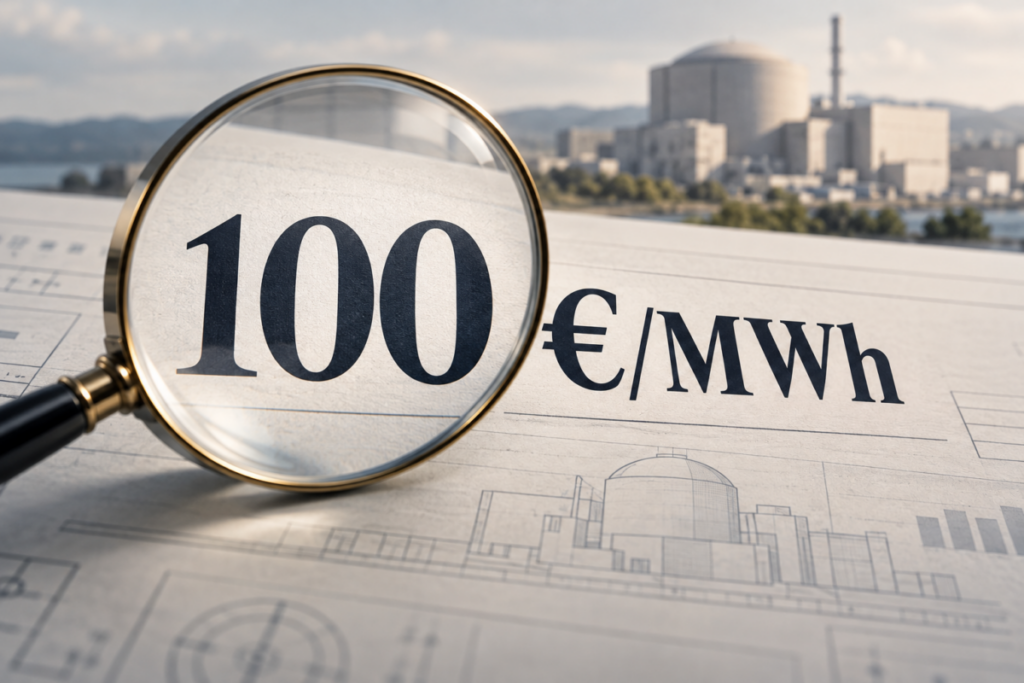
The cost of generating electricity from the future EPR2 reactors is a key issue in the energy debate. But a CfD at EUR 100/MWh tells us neither what that cost will be nor what consumers will pay: it indicates the level of secured revenue considered necessary to enable the investment.
The figure of EUR 100/MWh regularly comes up in the debate over the decision to build six new EPR2 reactors. But what exactly does it represent? The future cost of nuclear generation? Not exactly. The price paid by consumers? The cost to the State? Neither. To understand this figure and compare it with others, several different economic concepts need to be distinguished.
1. A CfD is first and foremost a revenue-stabilisation mechanism
The Nuclear Policy Council (CPN) of March 2025[1] announced a financing scheme for the construction programme of six EPR2 reactors based on “an interest-rate-subsidised State loan covering at least half of construction costs” and “a Contract for Difference [CfD] on nuclear generation with a maximum price of EUR 100 in 2024 euros/MWh”.
This CfD does not set the market selling price for EPR2 generation. It provides the investor with guaranteed revenue and greater visibility over future income. Building a nuclear power plant, a wind farm or a large solar facility requires significant capital investment today, which must generate returns over several decades. The wholesale electricity market primarily provides short-term price signals, which can be highly volatile. This uncertainty over future revenues represents a risk for investors, increasing financing costs through the risk premium and, ultimately, the cost of generating electricity. In the case of the EPR2 programme, the EUR 72.8 billion estimate in 2020 euros represents a substantial capital commitment, even for a company the size of EDF. Moreover, these investments will not generate revenue until the reactors enter service, around ten years later.
Following the 2021-2022 energy crisis, the European Union sought to clarify how the short-term market could be complemented by risk-sharing instruments designed to encourage investment in low-carbon energy by providing investors with greater visibility over long-term revenues, while protecting consumers against potential price increases in the event of another crisis. Regulation (EU) 2024/1747 on the electricity market, which entered into force in July 2024, therefore provides for the use of two-way CfDs for new publicly supported investments in wind, solar, geothermal energy, certain hydropower installations and nuclear power.
The principle is as follows. If the reference electricity price on the wholesale market is below the CfD strike price, the producer receives the difference. If it is above the strike price, the producer pays back the excess revenues in accordance with the terms of the contract. The State therefore does not pay the full CfD amount, but only the difference with the wholesale market price — and that difference can also be in the State’s favour.
The mechanism envisaged for the EPR2 reactors has one particular feature: support would not be calculated directly on the reactor’s actual output, but on the basis of a reference generation volume. In its decision to open an investigation,[2] the Commission explains that this architecture is intended to preserve incentives to optimise operation of the asset according to system needs, for example by reducing generation when prices are very low or negative. A similar mechanism, also based on a reference generation volume, is being considered for the new Dukovany reactors in the Czech Republic. This concept is already used in renewable energy contracts to preserve market signals.[3]
It should also be noted that the CfD envisaged for the EPR2 reactors would cover only 40 years, whereas the reactors are designed to operate for at least 60 years. EDF’s economic model therefore includes around twenty years of full exposure to market prices, during which its revenues will be subject to fluctuations in the fundamentals of electricity markets.
2. EUR 100/MWh is not directly the EPR2 generation cost
The EUR 100/MWh figure corresponds to the proposed CfD strike price. It is not a direct representation of the EPR2’s full generation cost, nor of its value to the electricity system.
One of the metrics used to estimate the generation cost of a given technology — without comparing technologies with one another — is the LCOE, or Levelized Cost of Electricity. It is calculated by adding together all discounted costs — investment, financing, operation, maintenance, fuel, decommissioning, etc. — and dividing them by the quantity of electricity generated over the entire operating life. The two values — the CfD strike price and the LCOE — are of course related, but they are not the same.
Nuclear power can benefit from variations in electricity market prices. For the CfD calculation, the reference used is the average market price for a constant, 24-hour-a-day generation profile, known as a baseload profile. However, French nuclear reactors do not always operate at constant output: they can adjust generation according to the needs of the electricity system, notably in response to changes in consumption and in wind and solar generation. This flexibility enables them to generate more when prices are high and reduce output when prices are low. The expected additional value of this load-following capability is taken into account from the outset when calculating the strike price, which tends to reduce it.
The calculation also takes the duration of the contract into account. The reactors will continue generating electricity after the 40-year CfD period ends. The revenues they may then earn from selling this electricity are estimated today and incorporated into the economic calculation. Depending on the assumptions used, taking this into account may increase the strike price required during the contract period.
Finally, the strike price is based on forecasts. It is set using estimates of construction, financing and operating costs. These costs may change during the project. The strike price must therefore not be confused with the LCOE, which measures the average cost of generating electricity over the lifetime of a facility according to a defined scope and set of assumptions.
In the event of construction cost overruns, the financing scheme provides for EDF to finance overruns of up to EUR 15 billion. If overruns were to reach between EUR 15 billion and EUR 30 billion, the additional amount would be financed 5% by EDF and 90% through an interest-rate-subsidised State loan. In this case, if the LCOE increased, the CfD would not, unless responsibility for the overrun could not be attributed to EDF or its suppliers (“legitimate grounds”[4]).
3. EUR 100/MWh is not the price paid by consumers
A CfD at EUR 100/MWh does not mean that households will pay EUR 100/MWh for their electricity either.
For a household on the regulated tariff, according to CRE,[5] the retail electricity price currently comprises around 40% for the supply component — electricity purchasing/generation, capacity, commercial costs and supplier remuneration — 29% for networks — RTE transmission and Enedis/local distribution networks through the TURPE network-use tariff — and around 31% for taxes, mainly VAT and excise duty.
As regards the supply component, electricity from the EPR2 reactors will be injected into a system comprising many other generating facilities: the existing nuclear fleet,[6] hydropower, wind, solar, thermal power plants, etc.
In practice, the supply component of the regulated electricity tariff (TRVE)[7] is calculated on the basis of wholesale electricity prices, to which commercial costs and supplier remuneration, among other elements, are added. On the European market, the short-term wholesale price is determined by the generation cost of the last power plant needed to meet demand, known as the “marginal plant”. When that plant is gas-fired, for example, its generation cost determines the price paid to all generators in that market, including those whose costs are lower, such as nuclear power.
To calculate the TRVE, CRE primarily uses forward market prices, which anticipate these wholesale prices and help smooth their fluctuations over several months.
The supply component of the regulated tariff therefore reflects market procurement costs. It does not reflect the actual generation costs of the French nuclear fleet. Nor does it reflect the amount of market premium support payments currently paid directly by the State to renewable energy producers. In the case of the EPR2 reactors, the State will likewise cover the cost of the CfD if the reference wholesale electricity price is below the strike price — and will receive the benefit if the opposite occurs.
As regards the network component of the TRVE, the TURPE paid by households increased by 7.7% in 2025 and then by 3.04% in 2026,[8] representing an increase of almost 11% over two years. In the longer term, CRE estimates that investment by RTE and Enedis should result in residential TURPE increasing by around 1% per year above inflation — equivalent to around 0.3% of the overall bill — until 2040.[9] This is intended to support electrification, connect new generation capacity — particularly renewables — and adapt infrastructure to climate change.
As regards taxes paid by consumers, it should be noted that, according to UFE,[10] taxes on electricity are unfortunately still twice as high today as those on gas and fuel oil. This remains a significant barrier to the electrification of end uses.
4. EUR 100/MWh: is it competitive?
Two technologies with a CfD of EUR 100/MWh, potentially based on very different designs, do not necessarily provide the same service to the electricity system.
Solar and wind power generate electricity according to weather conditions. As their share increases, their integration requires grids, interconnections, flexibility, storage or dispatchable capacity to ensure that generation and consumption remain balanced at all times. Nuclear power has other characteristics that are highly valuable to the grid: its output is dispatchable, and it provides voltage and frequency management services to the power system.
It may be tempting to compare the proposed EPR2 level with that requested for other new generation capacity, but such a comparison does not reflect the differences in the value[11] that each of these assets actually brings to the system, particularly in relation to the intermittency of available capacity.
In the French AO10 tender launched in 2026 for around 10 GW of offshore wind capacity across eleven projects, the Government set a target weighted average price below EUR 100/MWh — with some projects potentially above and others below — through market premium support contracts.
However, this does not mean that nuclear power and offshore wind cost the same on an equivalent basis, nor that they provide the same value to the electricity system. CRE[12] estimates that connecting the eleven AO10 projects will cost around EUR 20 billion. This cost is covered through the TURPE and is therefore not included in the costs covered by the market premium contracts.
More generally, CRE estimates that grid connection can represent 35% to 40% of the total cost of fixed-bottom offshore wind farms, equivalent to an additional EUR 30 to EUR 40/MWh that must be taken into account in the cost to the system.
The competitiveness of the EPR2 reactors can therefore only be assessed through an analysis of the overall cost of the electricity system, comparing a scenario in which they are built with one in which they are not, on an equivalent basis — the same level of security of supply, the same level of CO₂ emissions, etc.
This is, for example, the purpose of RTE’s Energy Pathways 2050 study, which is currently being updated. The first edition, published in 2021, concluded that using EPR2 reactors would help maintain controlled total generation costs by 2050, below those of 100% renewable pathways, which require substantially more storage and flexibility infrastructure. ■
By Valérie Faudon, Executive Director of Sfen
[1] Élysée press release – 4th Nuclear Policy Council meeting, 17 March 2025
[2] Document 52026AS119469 – STATE AID – France – Support for the construction and operation of six new nuclear reactors in France — Invitation to submit comments pursuant to Article 108(2) of the Treaty on the Functioning of the European Union
[3] Historically, support for renewables used “as-produced” CfDs, which created dispatch distortions. Today, renewable CfDs are based on actual generation when the price is above zero and therefore do not create volume risk arising from the difference between forecast and actual generation.
[4] Ibid. 2, page 14, paragraph
[5] Observatory of retail electricity and natural gas markets, Q4 2025
[6] It can be assumed that when Penly 3 EPR2 enters service on the grid in 2038, France will still have the 57 reactors of the current fleet, provided they are extended beyond 50 years, generating electricity at the highly competitive cost of EUR 60/MWh.
[7] Commission de régulation de l’énergie (CRE), decision of 14 January 2026 on regulated electricity tariffs.
[8] CRE publishes the annual change in tariffs for the use of public electricity networks as of 1 August 2026, 8 June 2026.
[9] CRE, RTE Ten-Year Network Development Plan prepared in 2025.
[10] UFE position on household energy taxation, 1 December 2025.
[11] The VALCOE indicator developed by the IEA seeks to incorporate these differences in value.
[12] CRE Decision No. 2026-95.