
EPR2: EDF develops its approach to keep construction on schedule
For its future EPR2 reactors, EDF is ultimately targeting a construction time of 70 months per reactor. To achieve this objective, the utility involved 35 companies in an in-depth review of construction site organisation, prefabrication, assembly and logistics. Around 150 workshops identified 29 major areas for optimisation, which have now been incorporated into the programme. The approach draws in particular on operating experience from Hinkley Point C and Chinese nuclear construction projects.
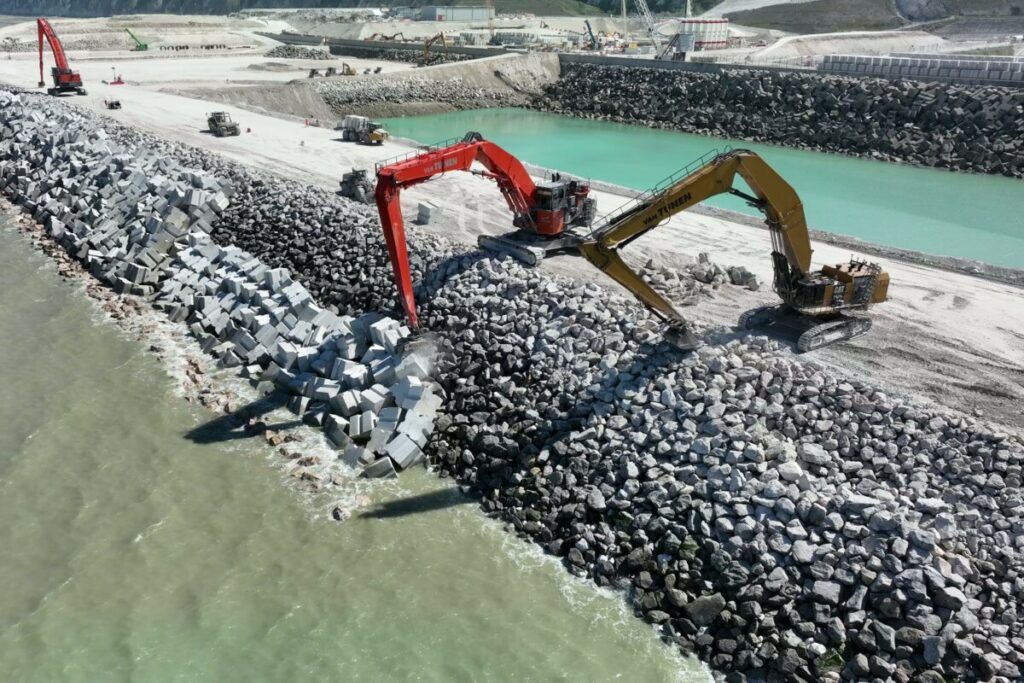
While preparatory works at Penly began in 2024 and are progressing rapidly, those at Gravelines received authorisation in August 2026. This is a first step in these vast, long-term construction projects. “The current schedule for Penly provides for first concrete in 2029, commissioning around 2036-2038, and the first electricity supplied to the grid in 2038,” said Henri Ansquer, EPR2 Programme Scheduling Manager at EDF. He was speaking during a webinar organised by Sfen last September. EDF’s objective is a construction time of 70 months for one unit, a target the company intends to achieve on the Bugey project.
Meeting these deadlines requires rigorous and precise preparation of the construction site. “As early as January 2024, a task force was set up to work on the Penly schedule. Then, during the summer, a target of 70 months for the construction of a generic unit was established, based on realistic assumptions,” said Estelle Obert, EPR2 Construction Performance Lead at EDF. EDF established the “70-month task force” to ensure that the same methods and organisational arrangements will be used for all six EPR2 reactors from the organisation and design phases onwards.
This working group, bringing together 35 partner companies, was divided by discipline and area of expertise: civil engineering; mechanical systems and ventilation; electrical systems; and testing. At the same time, participants carried out cross-cutting work on organisation, logistics and governance. “The objective was to involve partners as early as possible, even before final contracts were signed,” Henri Ansquer stressed. They took part in 150 thematic workshops over an 18-month period. “Every two weeks, the stakeholders met to identify and select the best proposals, with the primary selection criterion being a significant improvement to the schedule,” Estelle Obert added.
Consultation and optimisation
Overall, 29 optimisation opportunities, representing more than 200 actions, were approved by programme management and then incorporated into contracts, baseline schedules and costs. These optimisations include, for example: “Using prefabrication for complete components weighing up to several hundred tonnes, as on the Hinkley Point C construction site. This allows operations to be carried out not on the construction site itself, but on dedicated platforms.” Another example is bringing forward the assembly of the condenser.
“We now have a critical path that runs through the nuclear island. This was made possible by extensive work with Arabelle Solutions and CNEC (a major player in the Chinese nuclear industry, editor’s note) to accelerate assembly of the conventional island, construction of the pumping station and turbine hall, and assembly of the turbine-generator set,” explained the EPR2 Construction Performance Lead. The involvement of the Chinese teams helped consolidate EDF’s methodological basis and schedule “by grounding them in industrial reality developed with our partners. The aim was to compare different strategies rather than introduce breakthrough innovations,” Henri Ansquer explained.
Continuous work
Although the 70-month task force completed its work in December 2025, efforts to optimise the EPR2 construction schedule are continuing. “In addition to the 29 opportunities, we are managing 12 key medium- or long-term projects through twice-monthly committees,” Estelle Obert explained. Five of these projects have already been closed because they are “at least 85 % complete and have therefore now been incorporated into a permanent organisational framework”. Once again, the objective is to save time or make the schedule more robust.
These 12 key projects cover organisation — working time, logistics and prefabrication — as well as design and constructability, including roads, bringing equipment into buildings, backfilling sequences and the pool. One improvement, for example, concerns the assembly sequence for the main secondary system (CSP). Thanks to two innovations, EDF and Framatome plan to halve the time required to assemble these pipes connecting the steam generators to the safeguard buildings of the nuclear island. More broadly, EDF is also working to optimise the effective working time of teams on the construction site, with a target of seven hours of hands-on working time per day for each workstation. ■