
[Decoding] EPR2 programme: why and how is the State involved in financing?
France’s 2027 Finance Bill is beginning to translate the financing scheme for the six future EPR2 reactors into concrete terms. The State’s commitment, through a guaranteed and interest-rate subsidised loan, reflects the strategic nature of the programme, while the mechanism is designed to limit the risks borne by the public sector.
With the final investment decision (FID) for the construction of six EPR2 reactors expected by the end of the year, financing for the programme is entering a decisive phase. The 2027 Finance Bill is beginning to set out the scheme selected by the State: a loan from the Savings Fund of Caisse des Dépôts covering 60% of construction costs, guaranteed by the State and benefiting from interest-rate support. At the same time, the mechanism remains subject to review by the European Commission under State aid rules.
This financing does not provide for a grant, but for a loan that will be repaid from the revenues generated by the new reactors. It raises several questions: why should the State intervene, what will the cost of the interest-rate subsidy be, what risks will it bear, and does Caisse des Dépôts have sufficient resources? In this respect, the 2027 Finance Bill represents a key step in securing the programme schedule and clarifying the terms of public support.
1. Construction cost and financing cost: what is the difference?
It is important to distinguish between construction cost and financing cost. The construction cost of a facility corresponds to the expenditure required to build it — studies, land, materials, equipment, labour, etc. — irrespective of how these costs are financed. Financing cost, by contrast, corresponds to the price paid to access the capital required for the investment. It includes interest on borrowed funds and the return on equity invested.
Take the example of a new house sold for EUR 300,000. The buyer will pay the seller the same amount whether the property is purchased outright or on credit. If the buyer takes out a 20-year bank loan at 3.5%, in addition to repaying the principal, they will pay the cost of borrowing: around EUR 118,000 in interest. In this example, EUR 300,000 corresponds to the purchase price — the construction cost — and EUR 118,000 to the financing cost. Conversely, if the buyer pays cash for the house, they forgo the return they could have earned by investing their EUR 300,000 elsewhere, for example in life insurance or on the stock market. Financing cost therefore does not represent an increase in construction cost, but reflects the value of capital to the investor when making an investment decision.
Once this distinction has been made, a second difficulty arises: how can construction costs announced at different dates be compared? To neutralise the effect of inflation and enable comparisons between projects, major investments are often expressed in constant euros, i.e. in the value of money in a reference year.
For major projects, announced figures generally correspond to expenditure directly related to construction, excluding financing costs. This is also referred to as the “overnight” cost, as if the project were built instantaneously. In a recent article, Sfen compared the EUR 72.8 billion in 2020 euros for the EPR2 programme with the Grand Paris Express, estimated at EUR 36.1 billion in 2012 euros, and the Bordeaux–Toulouse high-speed railway, estimated at EUR 10.4 billion in 2020 euros. These figures exclude financing costs and are expressed in constant euros.
The same applies in the nuclear industry. The project to build three AP1000 reactors in Poland was announced at PLN 192 billion, or around EUR 45 billion in current euros, excluding financing costs. To compare construction costs between projects in different countries, the unit overnight cost per MW, expressed in $/MW, is often used. The OECD Nuclear Energy Agency (NEA) recently published figures[1] ranging, for 21 OECD countries, from USD 8,700 to USD 15,000/kW for large reactor projects planned in the short term, and from USD 2,487 to USD 6,791/kW for series construction.
The EPR2 construction estimate is expressed in constant 2020 euros and represents a unit overnight cost of around EUR 7,300 in 2020 euros/kW. Expressing the cost of the EPR2 programme in constant 2020 euros makes it possible to compare the real cost of the project with similar projects carried out at different dates by removing the effect of inflation. At the final investment decision, the estimate will be expressed both in 2020 euros and in 2026 euros. The reference year used for an estimate does not, in itself, indicate that the project has become more expensive or that cost overruns have emerged. It simply expresses the amounts in the value of money in a given year to facilitate comparisons.
Interest on borrowing and the return on equity must therefore be accounted for separately from construction costs. Interest depends less on what is being built than on how the project is financed and over what period.
2. Why is the State involved in financing?
State involvement in the long-term financing of strategic infrastructure is not specific to nuclear power. For the financing of EUR 6.4 billion of construction work on the Tours–Bordeaux high-speed rail line[2] in 2011, the financing package combined, in addition to the concession company’s equity, several billion euros of debt: bank debt guaranteed by the State, funding from Caisse des Dépôts through its Savings Fund, and loans from the European Investment Bank (EIB).
In its preparatory document for the 2027 Finance Bill, the Government described the project as contributing to the long-term strategic objectives of security of supply, decarbonisation of the economy and industrial sovereignty. The EPR2 programme is considered a strategic investment for the nation, justifying State involvement.
In its notification to the European Commission,[3] the French State argues that the market alone cannot finance the six EPR2 reactors. It identifies three market failures related to the scale of the financing required for construction before any electricity sales revenues are generated, uncertainty over very long-term electricity prices, and exposure to political and regulatory risks.
As permitted under the State aid framework, and following the precedent of the Czech scheme authorised by the Commission for Dukovany 5, France is proposing three instruments to address these three market failures: an interest-rate subsidised loan covering 60% of construction costs; a 40-year two-way Contract for Difference (CfD) with a strike price of EUR 100/MWh to provide revenue visibility; and a mechanism for sharing with the State certain risks beyond the project developer’s control.
At this stage, the Commission recognises the existence of the “clearly identified market failures” highlighted by France and the need for public intervention, but it must still assess whether the mechanism is proportionate.
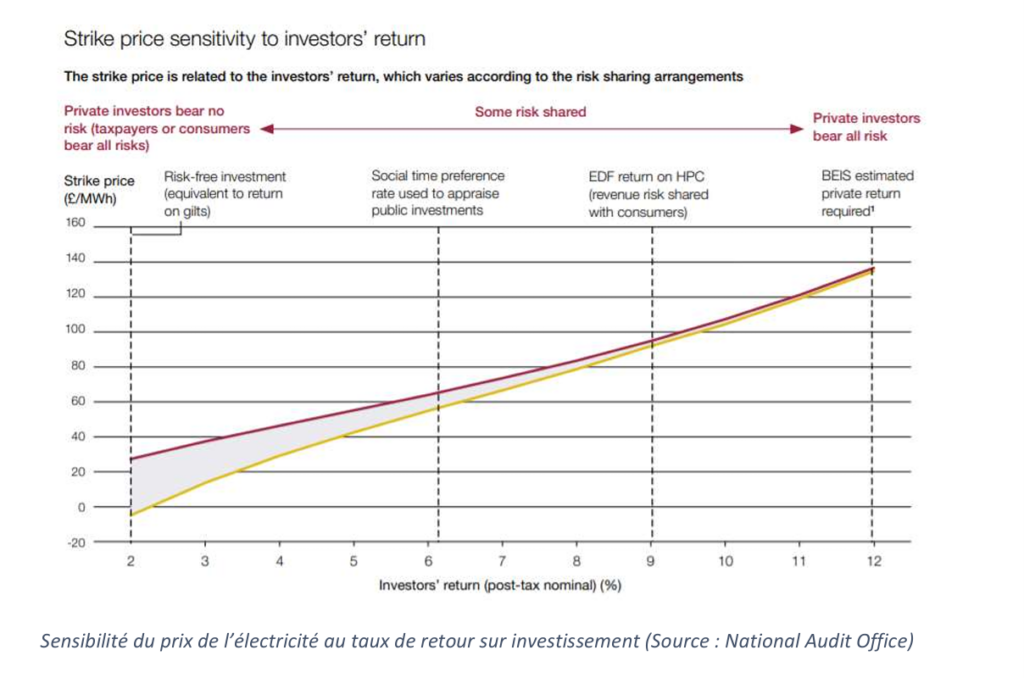
Sfen has shown in various publications[4] that the final cost of electricity generation is highly sensitive to the weighted average cost of capital (WACC). Mechanisms that provide an appropriate allocation of risks between consumers, taxpayers and investors reduce the risks borne by investors, lower the required risk premium and therefore reduce financing costs and, ultimately, electricity generation costs. A report by the UK National Audit Office[5] concludes that, in addition to a CfD — which addresses only risks associated with the electricity market — risk sharing between the investor and the State leads to a better overall outcome for society.
3. What cost and what risk for the State?
The 2027 Finance Bill states that: “Public support for the NNF programme (France’s new nuclear programme, editor’s note) will include, in particular, a loan from the Savings Fund (FE) of Caisse des Dépôts et Consignations (CDC) covering 60% of the estimated construction cost, up to a maximum of EUR 60 billion. This loan consists of six tranches (‘loans’), each corresponding to one reactor. The principal of each loan is amortised over 35 years, following a four-year repayment grace period beginning from the commissioning date of each reactor or, where applicable, a long-stop date. This loan is guaranteed by the State.”
To assess the public commitment in concrete terms, four elements must be distinguished: the nature of the loan granted to the project, the cost of its interest-rate subsidy, the scope of the State guarantee and the decision to use the Savings Fund of Caisse des Dépôts.
-
A public loan covering 60% of construction costs
The first important point is that the support does not take the form of a grant, but of a loan covering 60% of the reference construction costs — the EUR 72.8 billion estimate in 2020 euros.
This loan must be repaid by the project once each reactor enters service, using revenues from electricity sales adjusted according to the CfD. The mechanism is calibrated to provide EDF with a target after-tax return on equity of between 6.5% and 8.5%, therefore excluding costs covered by the loan. This return is consistent with the estimated cost of its equity and the risks it retains.
EDF bears the industrial risk and, in particular, will cover the first EUR 15 billion of cost overruns in the event of project delays. If overruns exceed EUR 15 billion, EDF will bear 10% of the additional amount and receive a new State loan for the remaining 90%, which it will also have to repay. In any event, these additional cost envelopes will not be covered by the CfD, except in the limited cases of legitimate grounds provided for under the risk-sharing mechanism. EDF therefore bears the industrial risks for which it is responsible through a reduction in its return.
-
An interest-rate subsidy that reduces financing costs
The second point concerns the cost of the interest-rate subsidy to the State. The State guarantees the project company a fixed interest rate of 0% during the construction phase and 3% during operation.
During construction, the State therefore covers the full financing cost of the loan associated with the Savings Fund, namely the Livret A savings rate plus one percentage point. However, this interest-rate subsidy does not represent a net cost to society. This support during construction enables the State to achieve savings during the operating phase through a lower cost for the CfD mechanism, whose strike price would otherwise have been higher. In simplified terms, society saves the difference between the target return and the financing cost of the Savings Fund loan.
The 2027 Finance Bill therefore provides EUR 137 million for the first year of the interest-rate subsidy. This expenditure will increase as the loan is drawn down during construction. The 2027 Finance Bill specifies that: “The amount of interest and ancillary costs of the loan covered by this guarantee depends in particular on changes in the Livret A rate, which is linked to inflation and short-term interbank rates, as well as on the pace of progress of the programme and cannot therefore, given the duration of the loans, be precisely assessed or capped under the State guarantee.”
For illustration, if the full EUR 60 billion loan ceiling were used, each percentage point of interest would represent EUR 600 million per year.
During the operating phase, the project company will pay a fixed rate of 3%. If the financing cost of the Savings Fund — the Livret A rate plus one percentage point — is below 3%, the difference will accrue to the State. If it is above 3%, the State will cover the difference.
For example, with a Livret A rate of 1.5%, the loan costs 2.5%: the project company still pays 3% and the State receives the 0.5 percentage-point difference. Conversely, with a Livret A rate of 3%, the cost of the loan reaches 4% and the State covers the additional percentage point.
-
A State guarantee that is not intended to be called
The third point concerns the State guarantee. As noted above, the CDC loan is guaranteed by the State.
A State guarantee is commonly used for Savings Fund financing, which is funded by French regulated savings products — Livret A, the sustainable development savings account and the popular savings account — which constitute almost all of the Savings Fund’s resources.
Likewise, loans from the Savings Fund are commonly backed by guarantees, notably in social housing, where these are generally provided by local authorities.
Although the State is required to provide an estimate of this guarantee in the 2027 Finance Bill, the guarantee is not intended to be called. In any event, the project’s annual revenues will be used as a priority to cover annual operating costs and then repay the CDC loan before EDF can recover and earn a return on its equity.
-
Using Caisse des Dépôts to limit financing costs
The final point concerns the choice of Caisse des Dépôts as the lending institution.
First, this choice allows the State not to carry the principal of the loan itself and therefore avoids having to raise the corresponding liquidity on financial markets at a time when France is already borrowing substantial amounts.
Furthermore, the current remuneration rate on regulated savings, which has been 1.7% per year since 1 August 2026, is lower than the cost of sovereign debt, whose 10-year benchmark yield stood at 4.90%[6] on 2 October 2026. Using the Savings Fund therefore reduces the cost of State support.
Although the loan will ultimately represent a significant commitment, it must also be considered in relation to the size of the Savings Fund, which stood at EUR 453.3 billion[7] on 31 December 2025, compared with EUR 440.8 billion at the end of 2024, an increase of EUR 12.5 billion.
This commitment, although significant in absolute terms and spread over time, therefore represents a fully manageable undertaking for CDC and the Savings Fund, compatible with CDC’s other commitments and consistent with its investment horizons.
In its presentation of the Savings Fund’s 2025 Annual Report, published on 18 May 2026, CDC stated that “this commitment will not constrain the Savings Fund’s ability to continue providing the social housing sector with low-cost loans distributed by Banque des Territoires.” ■
By Valérie Faudon, Executive Director of Sfen
Image – Copyright: @Xose Bouzas / Hans Lucas via AFP
[1] The Costs of Generating Electricity 2025
[2] Vinci: Tours-Bordeaux high-speed line: RFF signs with VINCI the world’s largest high-speed rail concession, 16 June 2011
[3] European Commission opening decision SA.119469, 31 March 2026
[4] Sfen, 13 October 2022, How to finance the renewal of the nuclear fleet? Building a financing model to guarantee competitive electricity for France
[5] National Audit Office, HPOC, 2017
[6] Agence France Trésor
[7] CDC 2025 Savings Fund Report