
Drought: why the Paks nuclear power plant came close to a complete shutdown
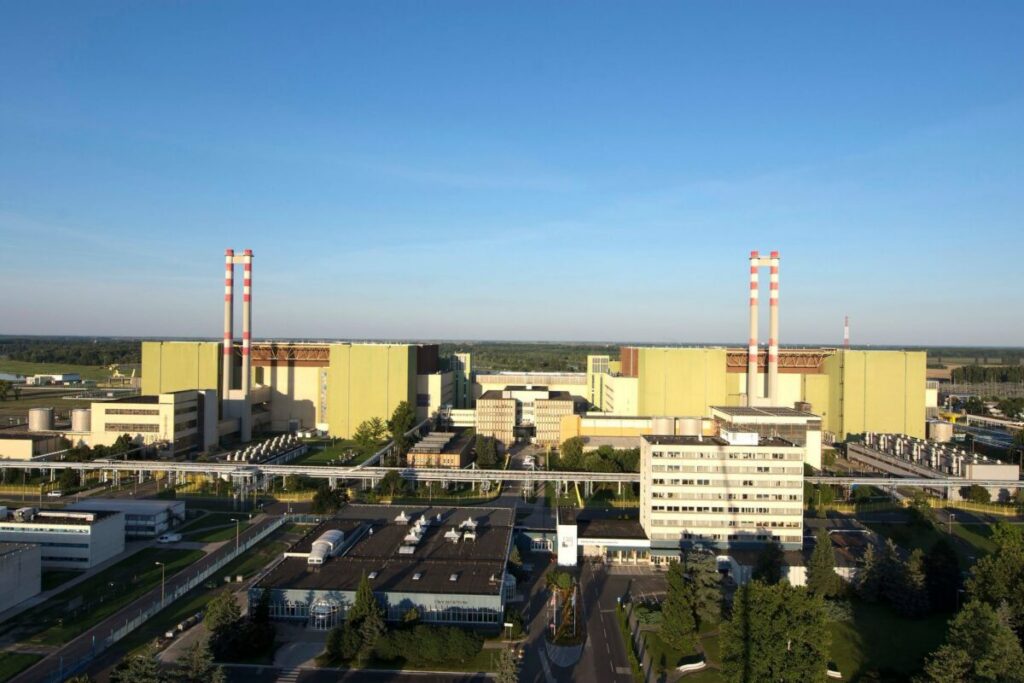 The Danube is currently experiencing historically low water levels, affecting the operation of Hungary’s Paks nuclear power plant. While the river flow remains more than sufficient to ensure reactor safety, the problem lies in the water level, which is currently too low to allow the cooling pumps to operate. The operator has announced a new infrastructure project to address these difficulties in the future.
Hungary is experiencing an exceptional drought in the summer of 2026, caused by a prolonged rainfall deficit and several heatwaves with temperatures locally exceeding 40°C. On 2 August 2026, the Paks 1 nuclear power plant came close to a complete shutdown of its four VVER-440 reactors, an unprecedented situation since it was commissioned 44 years ago. While the operator was preparing for this situation, the Danube water level rose slightly, allowing one of the turbines to remain in operation, the Prime Minister told Reuters on 4 August.
Sufficient river flow
Contrary to what might be assumed, the shutdown was not due to insufficient flow in the Danube, but to the water level at the intake having fallen too low to allow the cooling pumps to operate normally. In its statement of 30 July 2026, Hungarian operator MVM Paksi Atomerőmű states that the Danube flow remains sufficient to cool all four reactors. During operation, they require approximately 100 m³/s. This figure can be compared with the flow of 716 m³/s recorded at Paks on 3 August. It should be noted that the flow required to cool the reactors when shut down, in order to remove residual heat, is only 2.5 m³/s.
According to MVM, the water level has fallen below the elevation of the suction intakes, meaning that the pumps can no longer perform their function under the required conditions. “The water level of the Danube is currently 28 cm below the previous record low recorded in 2018 (more than one metre below the 100-year minimum water level taken into account when the nuclear power plant was designed more than 40 years ago),” it states.
No impact on nuclear safety
The fall in the water level is linked to two main factors: the deepening of the riverbed as a result of dredging campaigns and low sediment deposition, as well as the absence of major floods during the winter season. “Naturally, the nuclear power plant is prepared for exceptional situations, including those with a low probability of occurrence,” the operator continues. “We have developed procedures for managing periods of low water levels on the Danube.”
These procedures include several alert levels; at the highest level, all units must be shut down. To ensure cooling of the reactors once shut down, the plant also has a substantial fleet of mobile diesel pumps known as “Pajtás”, capable of performing essential safety functions. “The Pajtás pumps are available to continuously guarantee the water flow required to cool the nuclear power plant’s stationary units. Twelve of these pumps operate continuously, four are held in reserve and a further thirteen are ready to be deployed if necessary,” the operator states.
In its own statement, the Hungarian Atomic Energy Authority (OAH) emphasises that these power reductions and shutdowns are part of compliance with operating procedures and are not the result of a nuclear safety incident: “This operation has no impact on nuclear safety or the environment.”
Adaptation measures underway alongside Paks II
MVM stresses that a project is underway to lower the elevation of the suction intakes further, allowing the pumps to operate at even lower water levels. “These developments have already begun and, in accordance with our plans, electricity generation will be able to continue without interruption within a few years, even at significantly lower water levels,” the operator continues. Similar work has already been carried out at the site, particularly following a period of very low water levels in 1983. “This work made it possible to generate electricity at a water level 120 cm below the nominal level,” it states.
In parallel, the design studies for the two new Paks II reactors, two VVER-1200 units currently under construction in the same area, provide additional insight. They show that the facilities have been designed to operate with an extremely low Danube flow rate, of around 579 m³/s. Under this scenario, the simultaneous operation of Paks I and Paks II, representing a maximum water withdrawal of approximately 232 m³/s, is made possible by a new hydraulic configuration. Paks II includes a new water intake located approximately 400 m upstream of the mouth of the existing canal. The water will be conveyed through a new free-flow canal, then through a concrete structure to the pumping station. One of the objectives is to ensure sufficient water supply even during periods of low water levels.