
EPR2: Gravelines’ new foundation solution is “robust”, according to the French Academy of Technology
Following the ASNR’s reservations about an initial concept, EDF has developed a new ground reinforcement solution for the future EPR2 reactors at Gravelines. This new approach relies on more proven techniques while addressing the site’s specific geotechnical constraints. While the French Academy of Technology has issued an encouraging opinion on this new design choice, the safety authority is due to give its opinion on the matter as part of the review of the DAC this autumn.
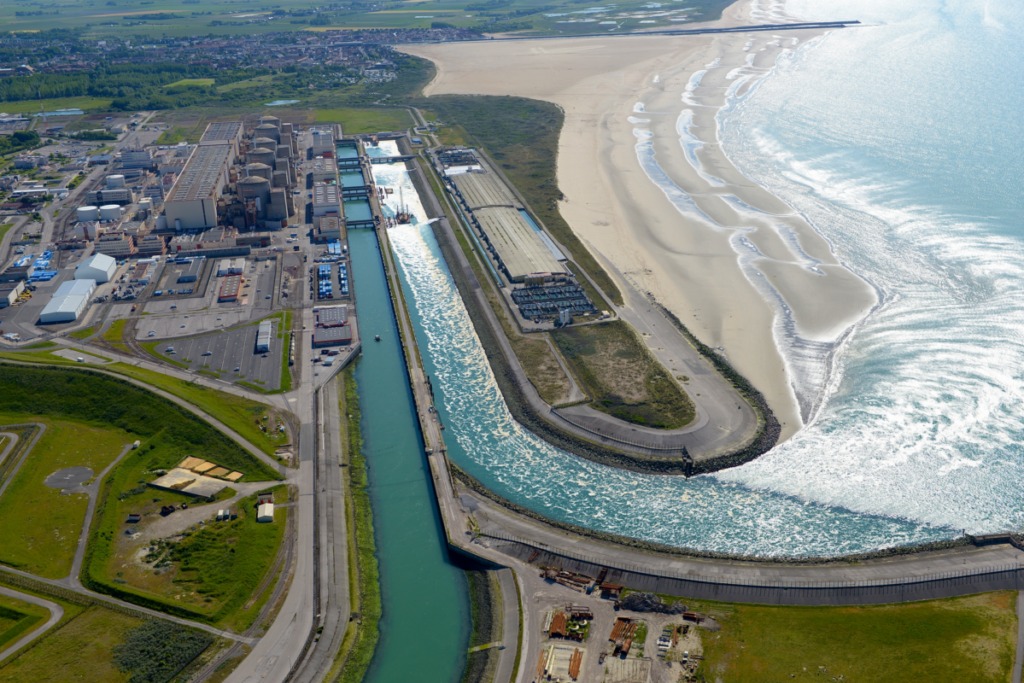
Building two EPR2 reactors at Gravelines poses an unusual challenge: the site is located on a polder, an artificial area reclaimed from the sea and made up of thick layers of sand and clay. Under the weight of the future buildings, these soils could settle unevenly. EDF must therefore implement a ground reinforcement process capable of ensuring the stability of the structures throughout their operating life.
A particular geotechnical challenge for the EPR2 reactors
The Gravelines site is artificially kept above water by a system of dykes, drainage and pumping. The site has a substantial thickness of soft soils. Without reinforcement, they could deform under the weight of the structures and cause differential settlement that could affect their stability.
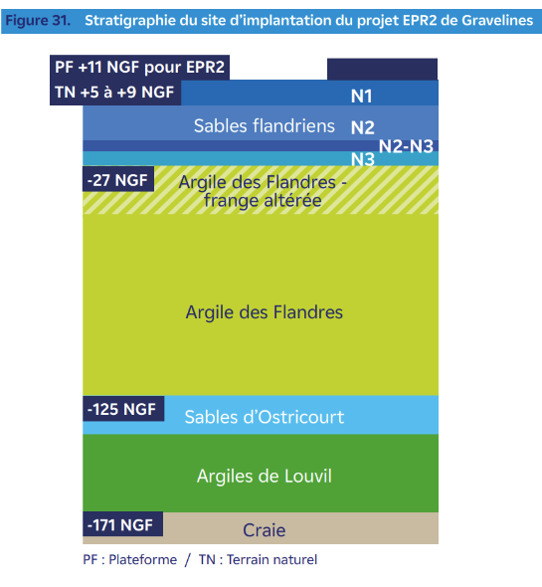
Beneath the EPR2 construction platform [1], there are several layers of sand (N1, N2, N3), followed by layers of clay, down to a chalk layer located approximately 180 metres below the surface. According to the Academy, the N2 and N3 layers (very dense sand) have good mechanical properties, whereas the N1 layer is more compressible and potentially susceptible to liquefaction under seismic loading. During an earthquake, certain water-saturated soils can temporarily lose their ability to support loads. The soil then behaves like a liquid, which can cause settlement or displacement of the foundations. Finally, consolidation of the clay layers under load can also cause settlement.
At Gravelines, the six existing 900 MW reactors were already built using specific ground treatment. They rest on a rigid load-distribution layer beneath the raft foundations, and the structures were given a preventive elevation allowance to manage settlement. Settlement observed on the reactors has been monitored since their construction and remains compatible with safety requirements. The situation for the EPR2 is different, with higher ground loads and more stringent design requirements.
More massive than the 900 MW reactors already present at the site, the EPR2 reactors are locally up to twice as heavy. This additional mass requires an unprecedented form of ground reinforcement to ensure the stability of the structures. According to the Academy, initial estimates show that, without ground treatment, the future EPR2 reactors could experience settlement of around 50 to 80 cm. By comparison, the six existing 900 MW reactors, built in a very similar geotechnical context, have experienced settlement of 25 to 30 cm.
The Academy nevertheless emphasises that, in practice, the important issue is not total settlement but differential settlement, in other words uneven ground deformation beneath the foundations that could be incompatible with the stability of the structures and their connections (galleries, piping).
A new solution following the ASNR’s reservations
In 2023, EDF began studies with a group of independent experts. The first technical solution proposed to limit settlement combined rigid inclusions (long reinforced-concrete “barrettes” drilled into the ground and not connected to the raft foundation) with soil mixing (a process that mixes the in-situ soil with a binder in order to stiffen it).
The ASNR issued an opinion on this solution on 23 July 2025. It considered that the concept was “unprecedented in scale” and had “no representative operating experience”, either in France or internationally. It therefore asked EDF to favour more proven techniques. The ASNR also asked EDF to provide additional justification regarding the effectiveness of the reinforcement system, its dynamic behaviour under seismic loading, as well as the results of additional geotechnical tests and investigations. Finally, it stated that technical discussions were continuing.
EDF brought together a second group of experts, including international expertise, between November 2025 and January 2026 to review the project. The selected solution retains the principle of rigid inclusions, but replaces soil mixing with compacted granular fill, a more proven technique. In practical terms, nearly 2,000 reinforced-concrete barrettes, approximately 50 metres long and arranged in a staggered pattern, are installed beneath the heaviest buildings.
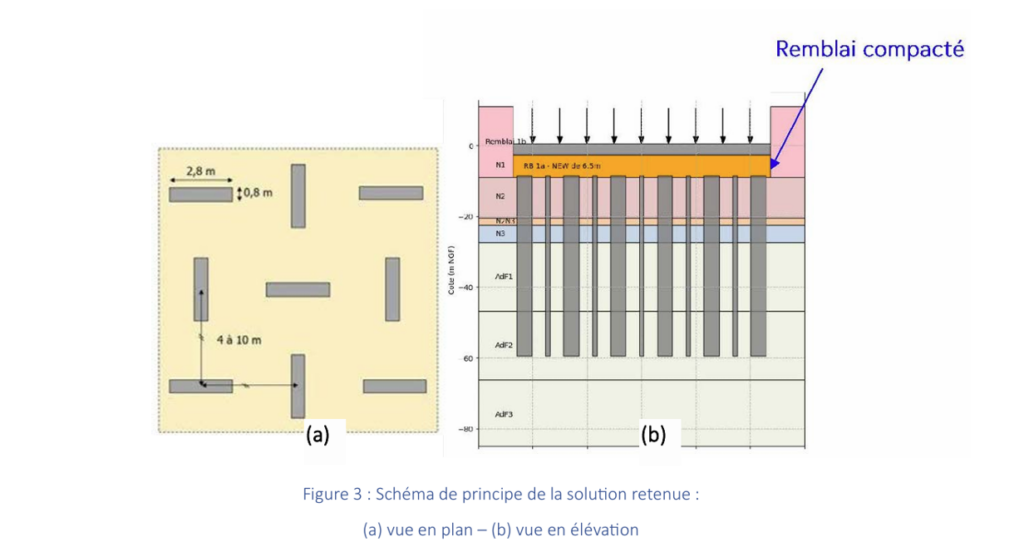
Unlike conventional piles, they are not directly connected to the raft foundation. A thick layer of compacted fill is placed between the barrettes and the foundations. This “self-balancing” system distributes the loads between the barrettes, the fill and the ground, thereby limiting the impact of any local failure.
Finally, to eliminate the risk of liquefaction, EDF plans to remove the entire N1 sand layer beneath the buildings, to a depth of around fifteen metres. It will be replaced by carefully selected and compacted fill whose mechanical properties will eliminate the risk of liquefaction and bring vertical settlement within a range of values acceptable for the structures.
A robust solution, according to the French Academy of Technology
The Academy, acting as a trusted third party, considers that the new design choice “is based on sound principles”, which have been confirmed by the initial experimental tests. It would limit settlement to values comparable to those measured on the 900 MW units. It concludes that “the selected principle is robust and makes it possible to manage the uncertainties inherent in the geotechnical characterisation of the site”. This ground reinforcement process, the first references for which date back around twenty years, benefits from extensive international operating experience, particularly for LNG (liquefied natural gas) tanks.
The Academy identifies several points requiring particular attention. It considers that excavation below the groundwater table will be challenging. Excavating 6 metres below the water level in saturated sands creates a risk of uplift at the base of the excavation. The Koeberg nuclear power plant in South Africa encountered a comparable difficulty, requiring the method to be adapted during construction.
Ensuring long-term durability
It raises the question of the durability of the barrettes: submerged for the planned one hundred years of operation in aggressive brackish water, they require concrete mixes and concrete cover specifically designed to limit the risk of corrosion.
Finally, it raises the question of long-term monitoring. Once constructed, these foundations will not be accessible for inspection. The Academy recommends integrating fibre-optic sensors and corrosion probes from the construction stage, combined with a “digital twin” of the structure capable of continuously comparing the actual behaviour of the building with model predictions.
By Valérie Faudon, Sfen
Graphics: EDF project owner’s file and French Academy of Technology
Image: Aerial view of Gravelines (Credit: EDF / Happy Days / Jean-Louis Burnod)
Note: [1] The EPR2 construction platform is planned at an elevation of +11 NGF, i.e. 11 metres above the conventional zero level linked to sea level in the Nivellement Général de la France (NGF) reference system of the Institut Géographique National (IGN).