
Grid frequency: how French nuclear power stabilizes the European grid
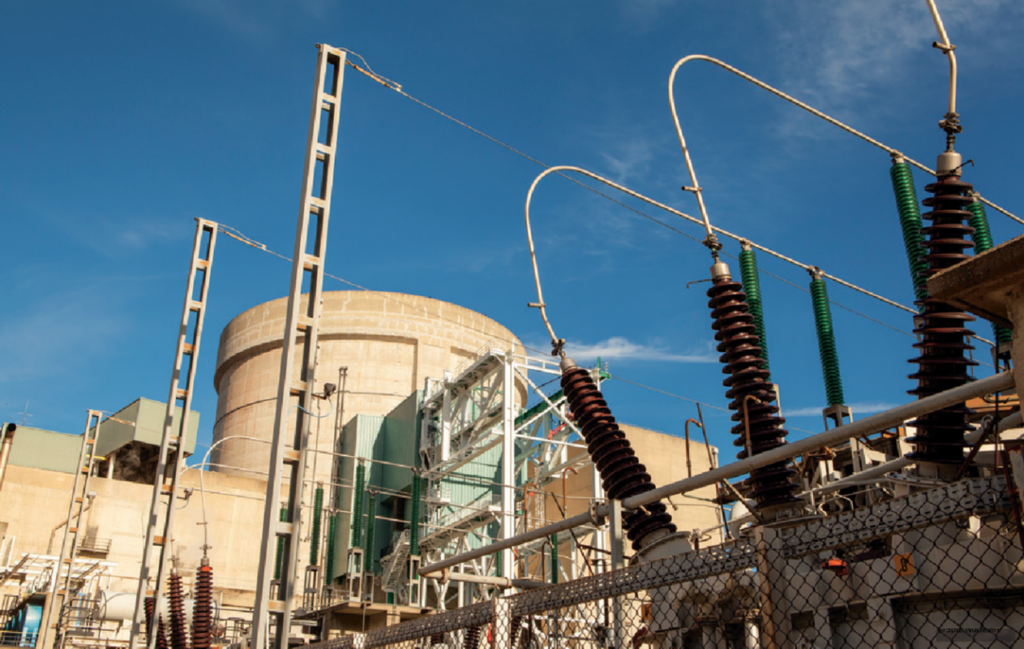
French nuclear power does more than generate low-carbon electricity: it also helps maintain the European power grid frequency at 50 Hz, an essential condition for grid stability and security of supply.
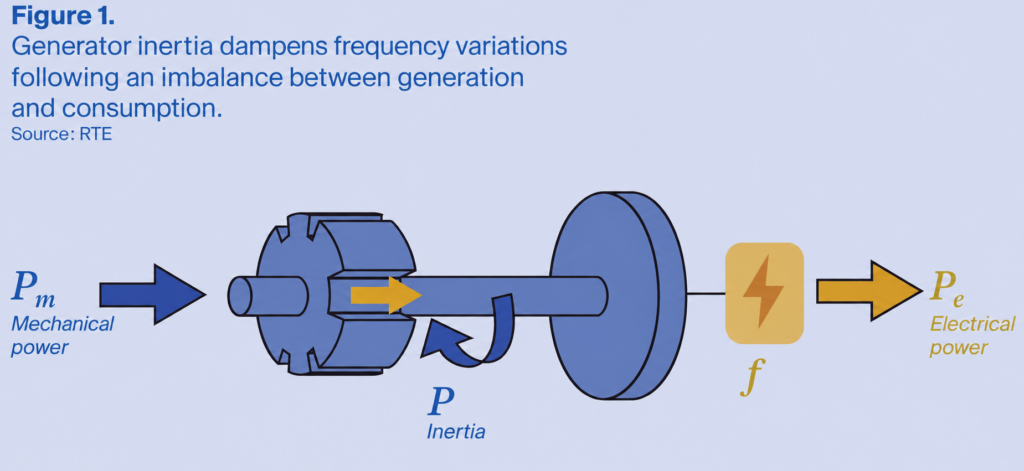
In an alternating-current power system equipped with synchronous machines, frequency (f) reflects the rotational speed of the generators. These convert the mechanical power supplied (Pm) into the electrical power (Pe) required by the grid. For example, the rotor of a nuclear power plant generator rotating at 1,500 rpm will generate a sinusoidal voltage at a frequency of 50 Hz. Any imbalance between Pe and Pm causes a change in mechanical speed and therefore a change in the electrical frequency of the grid. The rotating masses (nearly 1,000 tonnes) then act as kinetic energy storage, absorbing and releasing energy to compensate for these imbalances instantaneously. They provide inertia that “slows” variations in grid frequency (Figure 1).
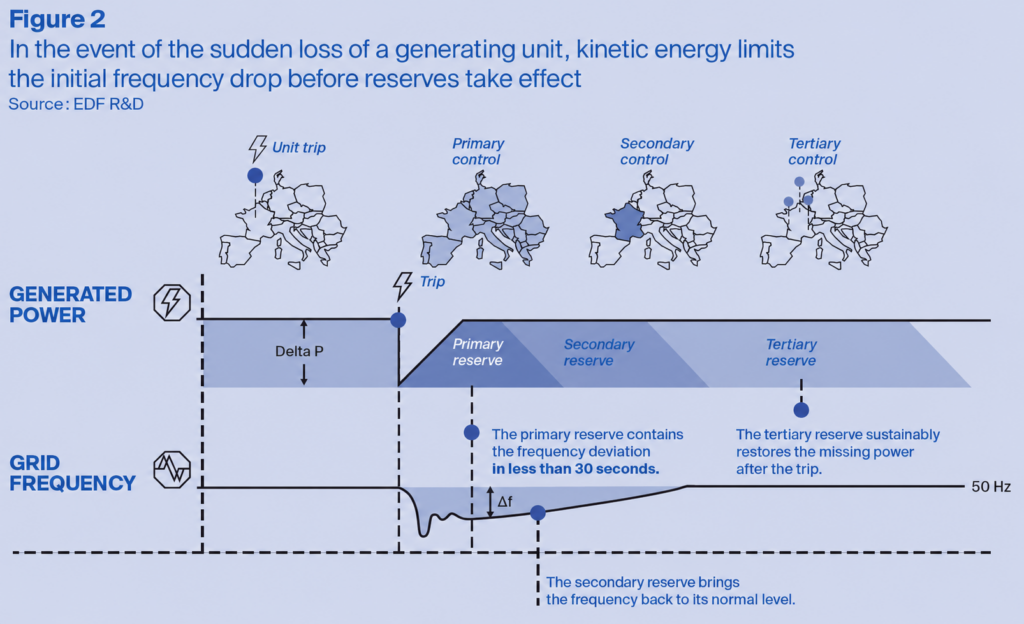
With 11 % of installed capacity, French nuclear power alone provides 30 % of Europe’s kinetic energy. This provides a service that supports frequency stability. The greater the kinetic energy, the lower the rate of frequency change in the first moments following a power imbalance. In the event of the sudden loss of a generating unit (Figure 2), frequency will fall more slowly and to a lesser extent before the planned balancing mechanisms come into play.
First, the primary reserve, which is the focus of this article, stabilizes the frequency. The secondary reserve then takes over until the frequency is restored to its nominal value of 50 Hz. Finally, the tertiary reserve is activated to replenish the primary and secondary reserves. To this end, generating resources that are offline may be called upon to start up.
With 11 % of installed capacity, French nuclear power alone provides 30 % of Europe’s kinetic energy. The greater the kinetic energy, the lower the rate of frequency change in the first moments following a power imbalance.
Primary frequency control, safeguarding the European balance
Primary frequency control is a service that acts automatically within a few seconds to maintain the real-time balance between generation and consumption across the European grid. For this service, which is essential to the proper functioning of the power system, power reserves are distributed equitably among the member countries of the European Network of Transmission System Operators for Electricity (ENTSO-E), in proportion to their annual generation. These reserves are then distributed among the various generation and storage technologies, including nuclear power in France, and are automatically activated in real time according to changes in frequency. An analogy can be made with cyclists on a tandem bicycle (Figure 3). On level ground, when the cyclists collectively maintain a constant pedalling force, the bicycle will maintain a constant speed: the (pedalling) frequency is constant. If the gradient suddenly changes (Figure 4), each cyclist will feel the bicycle slowing down: the shared (pedalling) frequency will decrease. Each cyclist then knows that they can pedal harder to limit the loss of speed without having to communicate with the others. This is the principle of primary frequency control: generation and storage resources simply measure the electrical frequency and adjust their power accordingly to stabilize the grid.
Performance exceeding grid requirements
Facilities participating in primary frequency control comply with regulatory requirements set by transmission system operators, including the amount of reserve capacity (in MW) made available, the power delivered according to the observed frequency deviation, and the speed at which that power is delivered. However, EDF’s nuclear fleet responds with dynamics that exceed the requirement. Among the requirements set by the transmission system operator RTE, the primary reserve must be fully delivered in less than 30 seconds. The nuclear fleet exceeds this requirement by delivering the entire reserve within just a few seconds. Frequency therefore stabilizes sooner and falls to a lesser extent following the loss of a generating unit. EDF thus provides an additional contribution to frequency quality, resulting in fewer deviations around 50 Hz.
In addition, EDF’s nuclear fleet also contributes beyond the required level in terms of power delivered. The primary reserve is delivered in proportion to the frequency deviation. Another requirement states that France must reserve around 600 MW, which must be delivered when a frequency deviation of 200 mHz is observed. Here again, French nuclear power plants participate in primary frequency control at a level well above contractual requirements. They deliver their entire primary reserve for frequency deviations of only around 40 mHz. Beyond this frequency deviation, they contribute above the required share. The power reserve available from nuclear power thus exceeded twice the required level for between 20 % and 50 % of the time each year between 2013 and 2017.
Quantifying EDF’s role in frequency stability
Like many participants in the power system, EDF has an impact on frequency stability. An imbalance between generation and consumption can, for example, occur following the unplanned shutdown of a generating unit or when generation setpoints change. Some non-dispatchable generation sources (hydropower, wind and solar) are also subject to fluctuations and forecasting errors.
EDF nevertheless acts to correct imbalances. Historically the main provider of frequency control in France, EDF plays an important role at European level. Its frequency-control performance appears favorable to the European system. An internal study set out to determine whether EDF contributes in proportion to the imbalances created or whether its control effort actually goes beyond this. Given EDF’s importance within the French generating fleet, France’s contribution was considered equivalent to that of EDF. The study quantifies and compares France’s contributions to the creation and correction of power imbalances at European level.
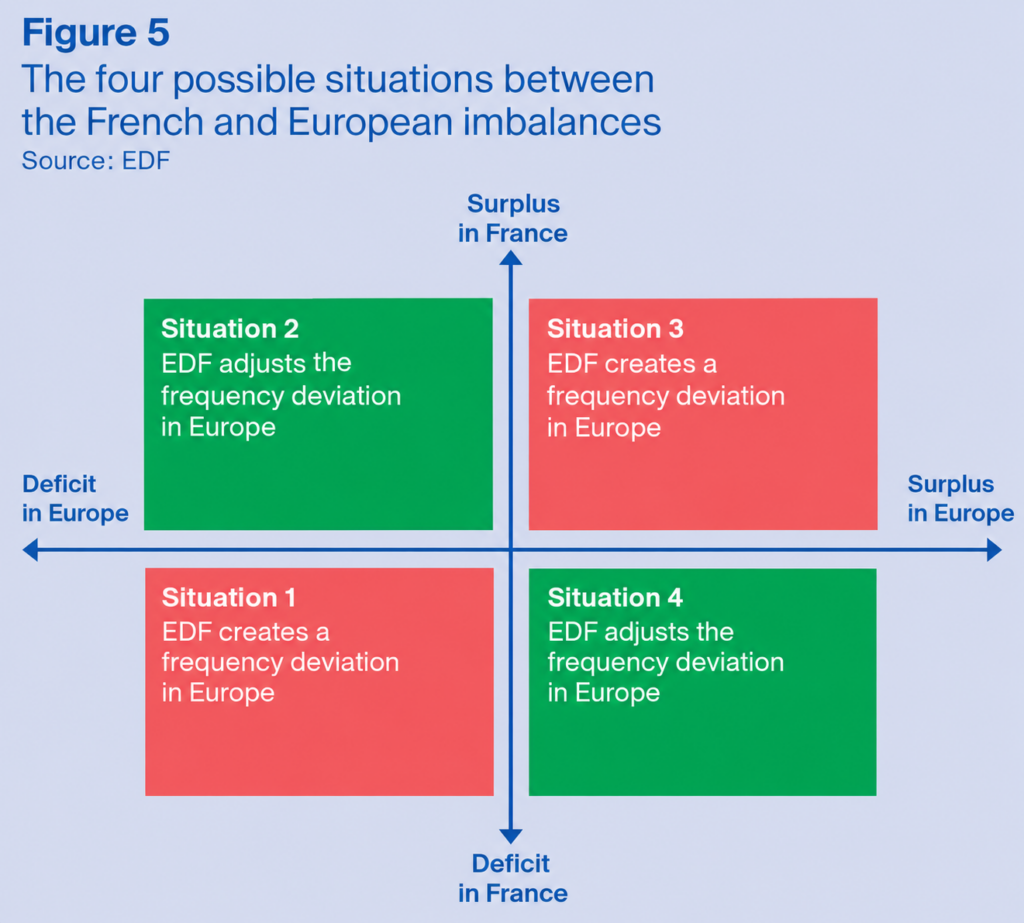
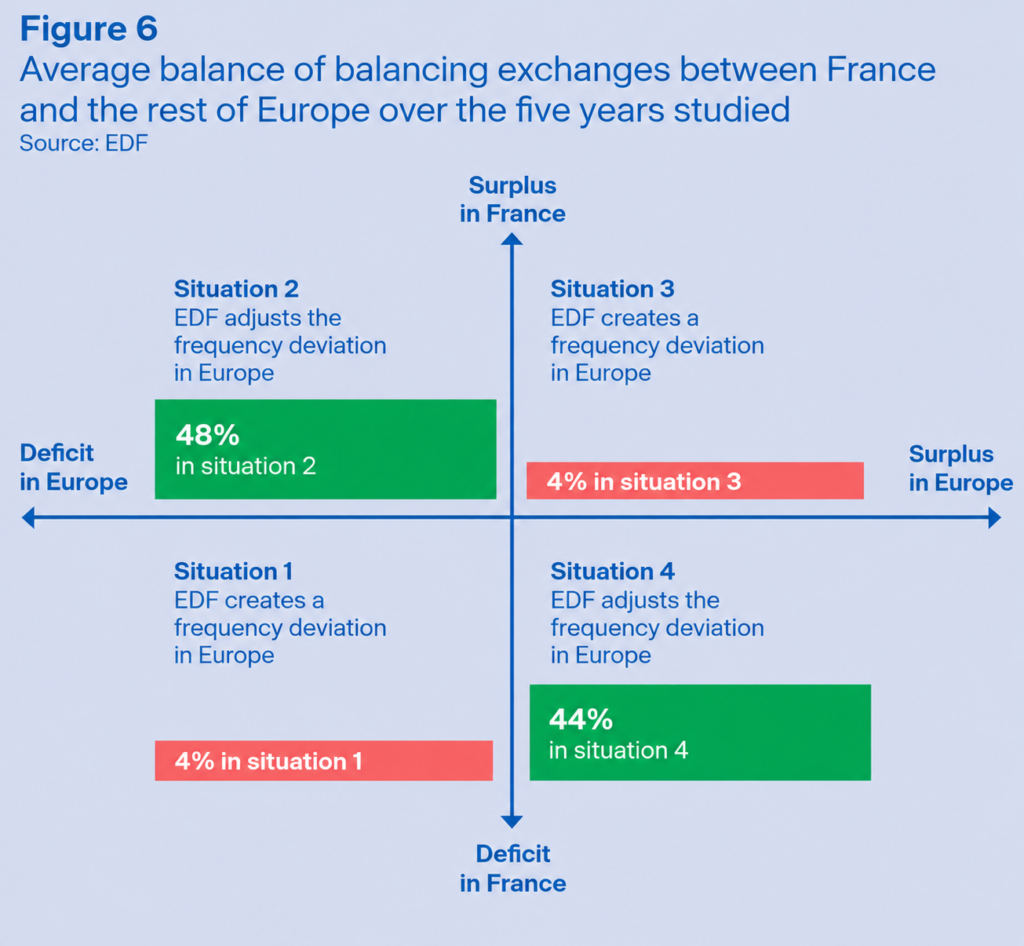
Four situations can arise depending on the direction of the frequency deviation and France’s contribution relative to the needs of the system (Figure 5):
↦ situation 1: generation deficit in France and Europe;
↦ situation 2: generation surplus in France and deficit in Europe;
↦ situation 3: generation surplus in France and Europe;
↦ situation 4: generation deficit in France and surplus in Europe.
Energy balances were calculated to determine, for each situation, whether electricity exchanges between France and the rest of Europe contribute to correcting the frequency imbalance (shown in green in Figure 5) or, conversely, contribute to worsening it (shown in red).
France contributes more to balancing than to imbalances. The results show that EDF’s participation is overall favorable to the system’s frequency-control needs, with France providing a net benefit to Europe in terms of balancing. EDF acts significantly more to support frequency stability than to contribute to imbalance, both in terms of time and energy. The energy activated in situations 2 and 4, supplied in line with the system’s needs, is substantially greater than that in situations 1 and 3, which contributes to imbalance. During periods of generation deficit in Europe, this difference is particularly marked: depending on the year, EDF supplies between ten and fourteen times more energy to correct the deficit (situation 2) than to increase it (situation 1). During periods of generation surplus in Europe (situations 3 and 4), France also contributes to restoring the balance by reducing its energy supply when the system requires it. The volumes of energy activated in this direction (situation 4) are 8 to 11 times greater than those contributing to the imbalance (situation 3), depending on the year.
Overall, France therefore contributes much more frequently to frequency control in the European system than to its imbalance. Depending on the situations considered and the year, the energy mobilized in support of balancing is between 8 and 14 times greater than that associated with worsening the imbalance (Figure 6).
Since this study, several changes have been made to frequency control in the European power system. Regulatory developments have mainly concerned secondary frequency control. This service is designed to restore frequency to 50 Hz and acts after primary frequency control, independently of it. These developments are not such as to alter the conclusions presented. Another change concerns the scheduling interval for generating resources, i.e. the time interval used to plan and adjust generation. At the time of the study whose results are presented above, French power plants changed their generation schedules only every half-hour. Today, all European power plants are encouraged to follow a market signal that changes every fifteen minutes. The intention was to reduce deviations between generation and consumption when schedules change. The beneficial effect has not yet been demonstrated. Frequency deviations remain of the same order of magnitude, as do frequency-control needs.
Batteries now contribute to frequency control, so the response expected from nuclear power has decreased proportionally. However, the physical characteristics of the nuclear fleet remain unchanged, and its ability to provide a rapid, large-scale service remains. ■
By Lionel Jamy, research engineer, with Grégoire Prime and Juliette Morin, EDF R&D
Image: @Spie Nucléaire