
Nuclear power: a new law to remove obstacles to major construction projects
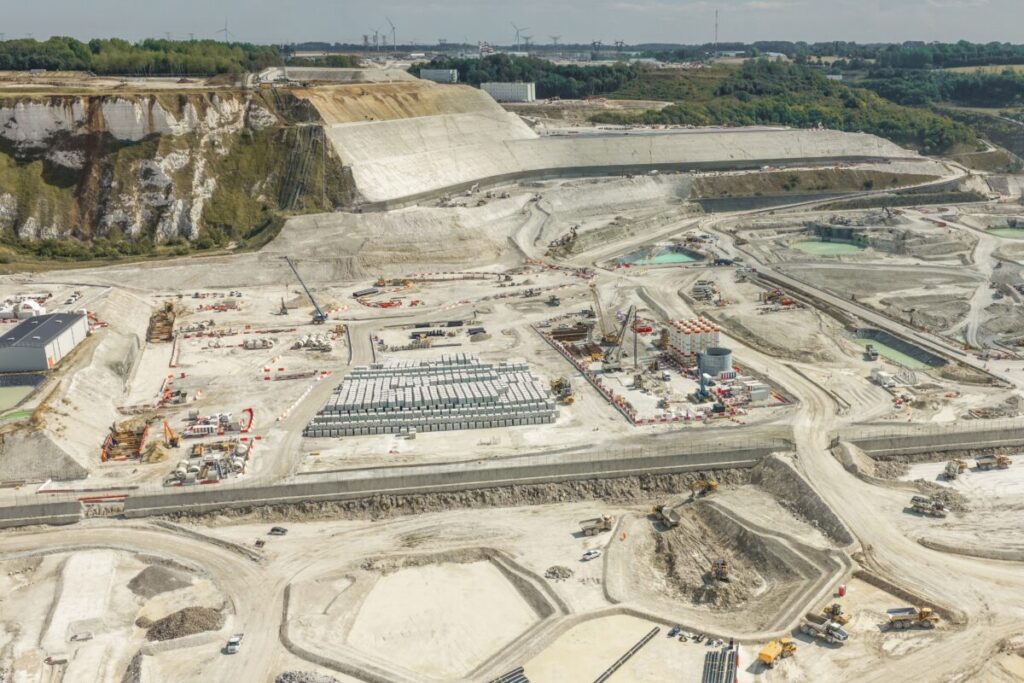
After facilitating the launch of preparatory works for the EPR2 programme, the French government wants to further streamline major nuclear projects. Presented on 14 October, a new bill would extend acceleration measures to fuel-cycle facilities, clarify the rules applicable to construction sites and ease certain constraints on industrial organisation.
The Nuclear Acceleration Act (ADN) is moving into its second phase. Three years after it entered into force, the government is seeking to build on legislation that has already made it possible to decouple environmental authorisation from the review of the creation authorisation decree. This notably enabled EDF to begin preparatory work for the Penly EPR2 project as early as 2024. The same applies to Gravelines, which received its environmental authorisation in August 2026, paving the way for earthworks and the construction of non-nuclear buildings.
As the formal launch of the EPR2 programme approaches, along with the Final Investment Decision (FID) expected by the end of the year, the government wants to complete this legislative framework. The bill, presented to the Council of Ministers on 14 October, proposes simplifications for the construction phase while also anticipating improvements for the reactors’ operating phase. “With this new legislation, the government is giving France the means to move from strategic directions to the actual implementation of projects, by providing industry with a framework suited to the scale of the investments and construction projects ahead,” the government report states.
1. Orano joins the acceleration drive with Aval du Futur
Article 1 of the bill provides for the acceleration measures to be extended to Orano’s Aval du Futur programme.
In practical terms, if the legislation is adopted, Orano will be able to begin site preparation and earthworks excluding nuclear foundations as soon as it obtains environmental authorisation, as is already the case for the EPR2 programme.
This measure would save around 18 months compared with the current procedure. This is a significant development given that the first phase of the programme provides for plutonium storage facilities to enter service in 2038, followed by new spent fuel storage pools and a MOX fuel fabrication facility from 2040.
These deadlines are critical for the industry, as they correspond to the currently projected dates at which existing storage capacity will reach saturation. To meet this schedule, Orano must be able to begin construction work in early 2031.
2. A consistent regulatory framework for construction sites
Of particular importance for the EPR2 construction sites, Article 1 simplifies the oversight regime for construction activities and facilities, notably compliance with regulations governing activities liable to affect the environment (ICPE), water-resource management (IOTA), and the protection of protected species.
At present, oversight falls under the authority of the Prefect until publication of the creation authorisation decree (DAC), which marks the site’s designation as a basic nuclear installation (INB).
From that point onwards, ASNR becomes the competent authority for oversight within the perimeter of the INB, while activities outside that perimeter remain under the authority of the Prefect. “This situation creates significant complexity in practice,” states the impact assessment accompanying the bill, which has been published by several media outlets.
The solution chosen by the government is therefore to maintain prefectural authority over environmental protection issues relating to construction activities throughout the project.
This is intended to harmonise requirements for construction equipment without calling into question ASNR’s authority to oversee operations involving nuclear structures.
3. Creating exemptions from the Construction and Housing Code
Article 2 of this new component of the Nuclear Acceleration Act aims to create exemptions from certain legal requirements where they “would increase risks in terms of nuclear safety or radiation protection, or prove technically impracticable”, the government explains.
Despite their specific characteristics, nuclear facilities remain subject to the Construction and Housing Code. Their construction is also governed by the 2020 Environmental Regulation (RE2020), the environmental standard applicable to new buildings.
However, some rules are incompatible with nuclear safety requirements, whether during reactor construction or operation. Requirements to install vegetation or solar panels on building roofs, for example, represent more of a constraint than an improvement for a nuclear power plant.
Another notable example is fire safety regulation. Managing fire risk in a nuclear area is highly specific and incompatible with the rules generally applicable to conventional buildings.
4. Streamlining contractor oversight
“Subject to prior authorisation from ASNR, operators will be able to entrust the oversight of external contractors to certain companies within their group,” the Council of Ministers report explains regarding Article 3 of the bill.
The aim of this measure is to reduce duplication in the oversight of contractors working for EDF subsidiaries. At present, the Environmental Code requires every nuclear operator to carry out this oversight itself, even if it has already been performed by one of its subsidiaries. This results in duplication of human and documentary resources across the group’s different entities.
Streamlining these controls would therefore enable EDF to draw on the specific expertise of Framatome, Edvance and Arabelle Solutions, while retaining responsibility for and control over the oversight process. This procedural simplification should optimise the contractor oversight process and therefore lead to considerable economic gains.
The details of the scheme still need to be specified, however: a decree must define the conditions for accessing the exemption, while its implementation will remain subject to ASNR authorisation based on an assessment of the technical relevance and effectiveness of the proposed organisation.
Beyond the EPR2 programme, this article could have other positive effects across the French nuclear ecosystem. The Orano group, for example, could use it to avoid duplication of expertise between its different entities: Orano Projets, Orano Aval du Futur, Orano Recyclage, etc. The measure could also benefit EDF by helping optimise reactor outages, particularly the oversight of second-tier subcontracting activities. ■