
Nuclear power: why the French trust it… and still have questions
Support for nuclear power has strengthened significantly and durably in France, without making the concerns associated with it disappear. The 2026 ASNR Barometer therefore paints a picture of public opinion that is less contradictory than it may seem: French people can support the construction of new nuclear power plants, trust the authorities responsible for oversight and, at the same time, remain concerned about radioactive waste or the risk of an accident. Behind these apparent contradictions lies a more complex mechanism of risk perception.
For more than 30 years, the ASNR Barometer has explored how French people perceive risks. Unemployment, pollution, health risks, road accidents: the survey first reviews the issues that concern society before focusing more specifically on nuclear power. The latest 2026 survey, conducted at the end of 2025, ranks cancer first among the 25 risk situations examined, cited by 77% of respondents, followed by drugs (76%), air pollution and terrorism (68%).
Nuclear power appears much further down the ranking. According to ASNR, the operation of nuclear power plants ranks 18th among the 25 risks examined, just ahead of radioactive fallout from the Chernobyl accident. At the same time, almost one in two French people (49%) say they support the construction of new nuclear power plants, a historically high level that has now stabilised after the sharp increase observed since 2020.
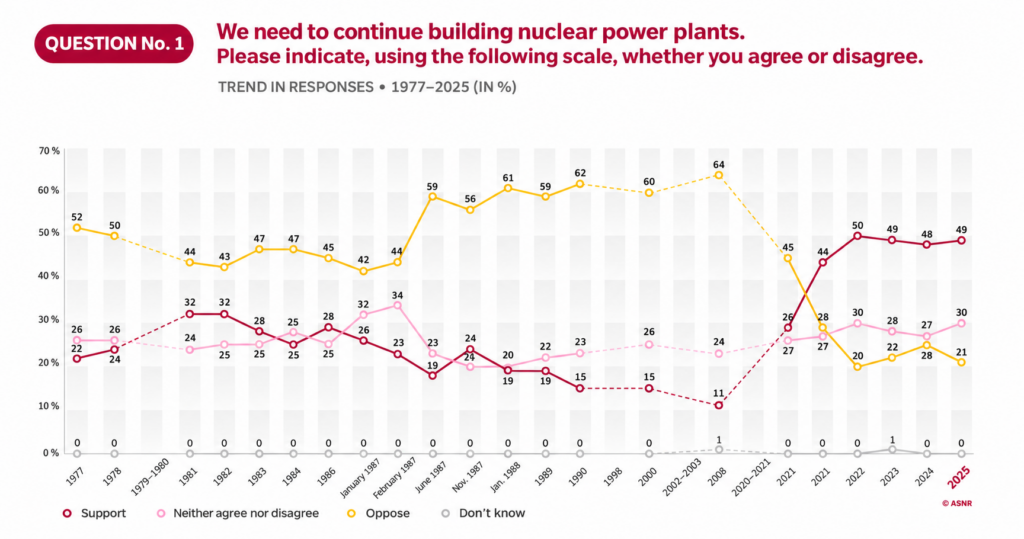
ASNR 2026 Barometer – Source: ASNR – Translation : Sfen
An energy source that reassures as much as it raises concerns
Since 2022, energy independence and the cost of electricity have remained the main arguments in favour of building new nuclear power plants. Low greenhouse gas emissions and the safety of nuclear facilities are also cited.
However, “for the sixth consecutive year, the production of radioactive waste remains the leading argument put forward by opponents of nuclear energy”, cited by almost one in three French people. This concern is linked to a feeling of insufficient information: 75% of respondents believe they are not sufficiently informed about radioactive waste storage, and 64% feel the same about risks.
Yet ASNR notes that in 2025, the operation of nuclear power plants “remains among the top three situations for which French people place the greatest trust in the authorities to protect them”. This apparent paradox above all shows that the perception of nuclear risk cannot be reduced to a simple opposition between trust and concern.
Current events shape risk perception
Risk perception is, first of all, highly sensitive to events. Fukushima in 2011 provides the clearest example. “The accident caused a shock in public opinion,” IRSN noted in its 2011 Barometer.
That year, 55% of French people considered the risk associated with nuclear power plants to be high, an unprecedented level. Distrust of the authorities responsible for overseeing nuclear facilities also increased: only 24% of French people said they trusted them at the time.
Following the November 2015 terrorist attacks, terrorism in turn became a major concern in the 2016 Barometer. Finally, in the Barometer published in 2021 following the Covid-19 pandemic, health was added to the questionnaire and immediately rose to the top of the list of concerns.
The role of collective responsibility
Public opinion is not shaped by current events alone: collective responsibility also plays a role. The more French people feel collectively responsible for their exposure, the more likely they are to consider the associated risk to be high.
This correlation is particularly marked for radiotherapy accidents, medical X-rays, nuclear power plants and radioactive waste. Nuclear-related risks are therefore not perceived solely as individual hazards: they are also associated with collective societal choices, which contributes to their symbolic significance.
A personal and collective relationship with risk
Personal experience of a risk does not automatically determine how much fear it generates, the 2022 Barometer shows.
Smoking is the risk French people say they have encountered most frequently (52%), yet only 34% consider the risk to themselves to be high.
Terrorism shows the opposite pattern: only 7% say that they or their relatives have personally experienced it, yet 40% consider the risk high for themselves and their relatives, and 70% consider it high for French people in general.
A risk therefore does not need to have been personally experienced in order to be feared. More broadly, French people tend to feel less personally exposed than they believe society as a whole to be.
Trust that cannot be taken for granted
The 2026 edition therefore confirms a lasting shift in how French people perceive nuclear power. Trust in the authorities responsible for oversight nevertheless coexists with a persistent feeling of insufficient information, particularly regarding radioactive waste and accident risks.
For both the nuclear industry and public authorities, the challenge is therefore to preserve this trust while addressing the concerns that remain.
Ultimately, the paradox may be less contradictory than it first appears: French people can consider nuclear power necessary, trust those responsible for overseeing it and continue to question its risks. ■