
Why build EPR2 reactors rather than other reactor designs?
Choosing a reactor is not simply a matter of comparing capacity, headline costs or construction times. The EPR2 already represents ten years of engineering work, ongoing regulatory procedures, mobilised suppliers and an industrial organisation currently being rebuilt. Changing technology today would therefore mean reopening far more than just the reactor design.
As France prepares to commit tens of billions of euros to the construction of six EPR2 reactors, the choice of reactor itself is still sometimes questioned. Why not return to the original EPR design, purchase the American AP1000, or develop an entirely new design based on the N4, the last reactor model to be built as a series in France? Behind this question lies an issue that extends far beyond the reactor’s technical performance: France’s ability to rebuild a genuine industrial series.
Experience from the French nuclear programme of the 1980s and the current performance of Chinese construction projects show that controlling construction costs depends less on the intrinsic characteristics of the reactor than on the ability to deploy a genuine industrial standard. Beyond product standardisation, what is essential is an organisation capable of efficiently reproducing the same model, based on a stable design, a sustainable industrial supply chain, controlled and repeatable processes, and the continuous integration of operating and construction experience.
France has chosen to standardise around the EPR2. It has adapted the design to meet its regulatory requirements and needs, invested millions of engineering hours and mobilised the entire domestic industrial supply chain — around a decade of work. Changing reactor model today would require design studies to be redone, the industrial supply chain to be adapted and the entire authorisation process to begin again. Such a decision would cost billions of euros and, beyond the resulting delays, could lead to a potentially permanent disengagement of industrial players and host regions. Such a change would therefore put at risk France’s ability to maintain an industry capable of designing and building its own reactors.
Why not simply replicate the Flamanville EPR?
The EPR now has operating references in China, Finland and France. Four units are currently under construction in the United Kingdom. Its design is well understood, and the difficulties encountered on the first projects have generated substantial experience.
Abandoning the EPR2 would mean forfeiting precisely the benefits of the improvements made as a result of experience from these earlier projects. The EPR2 is designed to be easier to build. It retains the main safety principles of the EPR while simplifying its architecture. Its containment has a single wall instead of two. Its safety systems are organised into three trains instead of four, a choice that combines experience from the EPR with requirements for independence between lines of defence, while limiting the complexity of the installation. The layout of the buildings has been rationalised, notably through better alignment of walls and load-bearing structures. The component catalogue has also been standardised to reduce the number of references and facilitate series production.
The EPR2 is also designed to be easier to operate. Extensive work has been undertaken to better integrate operators’ requirements into the design from the outset, particularly in terms of equipment accessibility. One objective is to facilitate maintenance operations and contribute to a high level of plant availability. The EPR2 also incorporates the expected effects of climate change from the design stage, in line with the measures being implemented across EDF’s operating fleet, with margins and adaptation capabilities intended to ensure its safety and availability over the long term.
Designing the EPR2 has represented a considerable engineering effort, totalling 14.7 million working hours by the end of 2024. Following completion of the Basic Design phase, the Detailed Design of the main systems and buildings began in summer 2024. The programme has since passed further milestones, while ASNR’s review of the creation authorisation application for the Penly 3 and 4 reactors is due to be completed by the end of 2026.
In practice, even though returning to the original EPR would remain technically possible, changing reactor model today would require a large part of the public consultation and authorisation procedures to be restarted. The public debates already held, particularly the Penly debate in 2022–2023, explicitly concerned a programme of six EPR2 reactors. New environmental and creation authorisation applications would therefore have to be submitted and subsequently reviewed by the Environmental Authority and ASNR respectively.
Such a change would result in several years of delay and could disrupt the teams currently mobilised on construction sites, in factories and in the engineering offices of EDF and its suppliers. A significant share of contracts with the supply chain has also already been awarded on the basis of the EPR2 design. Returning to earlier specifications would notably require component catalogues to be revised, certain manufacturing activities already under way to be redirected and some supplier contracts to be renegotiated.
Why not choose an American reactor?
AP1000 reactors are operating in China and the United States. These industrial references are an asset. But a reactor built abroad is not necessarily immediately ready to be built in France.
The first challenge concerns adaptation to French nuclear safety requirements. The AP1000 is based on its own technical choices. In the event of a severe accident, for example, it relies on retaining and cooling the molten core inside the reactor pressure vessel, whereas the EPR2 incorporates a core catcher. The AP1000 also makes extensive use of passive safety systems, notably relying on gravity and natural fluid circulation. These differences do not mean that one model is inherently less safe than another. But adopting an AP1000 in France would require demonstrating compliance with French requirements. ASNR’s review could result in requests for additional justification, testing or design modifications. Some of these adaptations could have knock-on effects on design maturity and the schedule. An AP1000 adapted to French requirements would therefore, in this context, effectively become a first-of-a-kind design.
The specific requirements of the French electricity system and EDF would also have to be taken into account. The EPR2 has been designed to provide significant load-following capability, allowing its output to be adjusted in response to variations in demand and the development of renewable energy. It also provides for the possibility of using MOX fuel, in line with France’s plutonium recycling strategy. Additional studies and probably design modifications would be required to guarantee these capabilities on an AP1000.
The second challenge is industrial. French factories, particularly those operated by Framatome, have equipment and processes adapted to the technologies used in the existing fleet and the EPR programme. The AP1000’s large components have different dimensions and metallurgical specifications. The new projects in Poland and the United States envisage manufacturing in South Korea. Producing these components in France would require checking the compatibility of existing facilities, adapting tooling and processes, and then qualifying manufacturing in accordance with French nuclear pressure equipment regulations (ESPN).
For several decades, the French nuclear industry has relied on the RCC-M code, which is adapted to its reactors and to French regulations. The AP1000, by contrast, was developed according to other standards, particularly the American ASME code. Switching from one framework to the other would require some calculations, manufacturing processes and inspections to be revised.
Adapting the AP1000 to French safety and operating requirements, as well as to the capabilities of the domestic industrial supply chain, would therefore entail additional costs and significant delays. This would be in addition to the acquisition of licensing rights. The remaining question is whether these adaptations would offer a significant advantage in return. To date, the AP1000 has not demonstrated an economic advantage over the EPR2. In China, construction times for AP1000s and EPRs have been comparable. China carried out a complete re-engineering process (Chinese standards, local equipment, no aircraft-crash protection design, etc.) and developed the CAP1000. The difficulties encountered at the Vogtle project are now leading the United States to seek Korean support for the construction of six AP1000 reactors in the country. In Poland, the cost of the three-AP1000 programme has been announced at around EUR 44 billion, or EUR 11,700 per installed kW, compared with EUR 7,300/kW for the six French EPR2 reactors (EUR 72.8 billion for almost 10 GW).
The same difficulties would arise if France decided to build a Korean reactor. This reactor benefits from a highly integrated Korean supply chain. As part of its deployment in the Czech Republic, the industry has had to address two major challenges: design modifications to meet the requirements of the European Nuclear Safety Directive, and the integration of Czech industry, led by Škoda. It should also be noted that Korean company KHNP recently announced that it had ended negotiations with the Daewoo-Doosan consortium for the construction of the two Dukovany reactors, following a disagreement over risk-sharing and responsibility for additional costs associated with design adaptations.
As for China, the country reports remarkable domestic performance from its ongoing programme of 37 Hualong One reactors, in addition to the ten already in operation. However, experience from the construction of two reactors for export at the Kanupp site[1] in Pakistan shows overnight costs almost twice as high.
Why not develop an entirely new design based on the N4?
This option would be technically feasible, but it would require a large part of the design work carried out for the EPR to be repeated. The N4 reactors were developed in the early 1980s, under safety requirements that have evolved considerably since then. ASNR now requires enhanced protection against external hazards. It also requires severe accidents involving core meltdown to be addressed from the design stage, with measures to limit their radiological consequences.
Starting again from the N4 would therefore require an entirely new cycle of design work and safety demonstrations. The experience of the EPR illustrates this. Developed from the French N4 and the German Konvoi, it required almost fifteen years of studies between the start of its design in the late 1980s and the launch of construction of the first unit at Olkiluoto in 2005.
Delaying construction by 10 to 15 years would cause lasting disruption to the industry. The construction of the first four EPRs in China, Finland and France, followed by the four units currently under construction in the United Kingdom, has made it possible to train new teams and rebuild valuable industrial capabilities. Without visibility over future orders, some suppliers could redirect their resources towards other sectors, particularly aerospace or defence. More broadly, uncertainty over the future of the programme would weaken the entire industry’s ability to attract, recruit and train the skills it needs. Beyond costs and schedules, France’s sovereignty would be at stake: its ability to design and build its own reactors, but also to maintain its position in an industry that is strategic for the energy transition and currently undergoing a global revival.
Staying the industrial course rather than reopening the technology debate
Thanks to the preparatory work carried out notably since the Belfort announcement in 2022, France now has a programme that has reached a high level of maturity. It has selected a design that meets its safety requirements and the needs of its electricity system. The design maturity milestones required for the Final Investment Decision have been reached, while ASNR’s opinion on the creation authorisation application is expected in the coming weeks. Soon, all the milestones relating to public dialogue and regulatory authorisation will have been reached. Manufacturing of long-lead components has even begun in order to maintain the schedule. At Penly, 1,500 people are working on earthworks and site preparation.
With the design now stabilised and the schedule rigorously structured, the focus is shifting towards industrial execution. The success of the programme will now depend on the industry’s ability to maintain production rates, manage the supply chain, develop the necessary skills and capitalise on the benefits of series construction. Successfully ramping up industrial capabilities will therefore be key.
EDF says its ultimate target is a construction time of 70 months per reactor. In a recent webinar organised by Sfen, the utility explained how it brought together 35 companies for extensive work on construction-site organisation, prefabrication, assembly and logistics in order to secure the schedules. Around 150 workshops identified 29 major areas for optimisation, which have now been incorporated into the programme. The approach draws in particular on experience from Hinkley Point C and Chinese nuclear construction projects. ■
By Valérie Faudon, Executive Director of Sfen
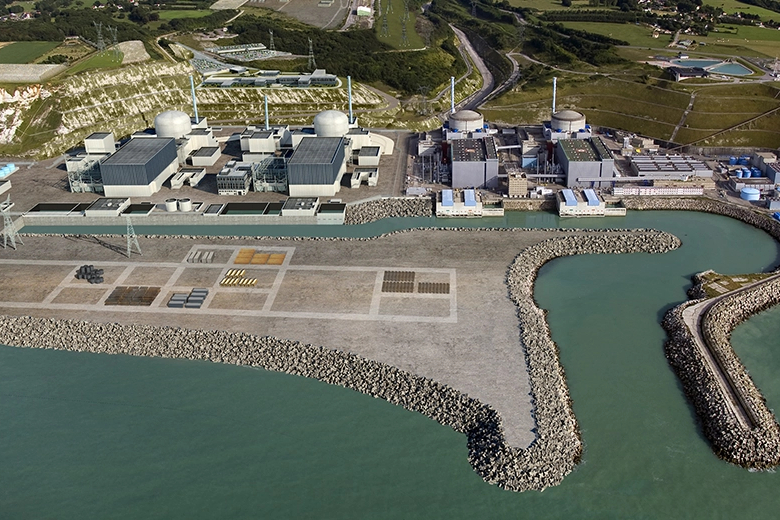
Image: On the left, a rendering of the two EPR2 reactors to be built at Penly – @EDF
[1] Express Tribune (Pakistan), 6 June 2013.