
Uranium: sufficient resources, provided investment starts now, says the Red Book 2026
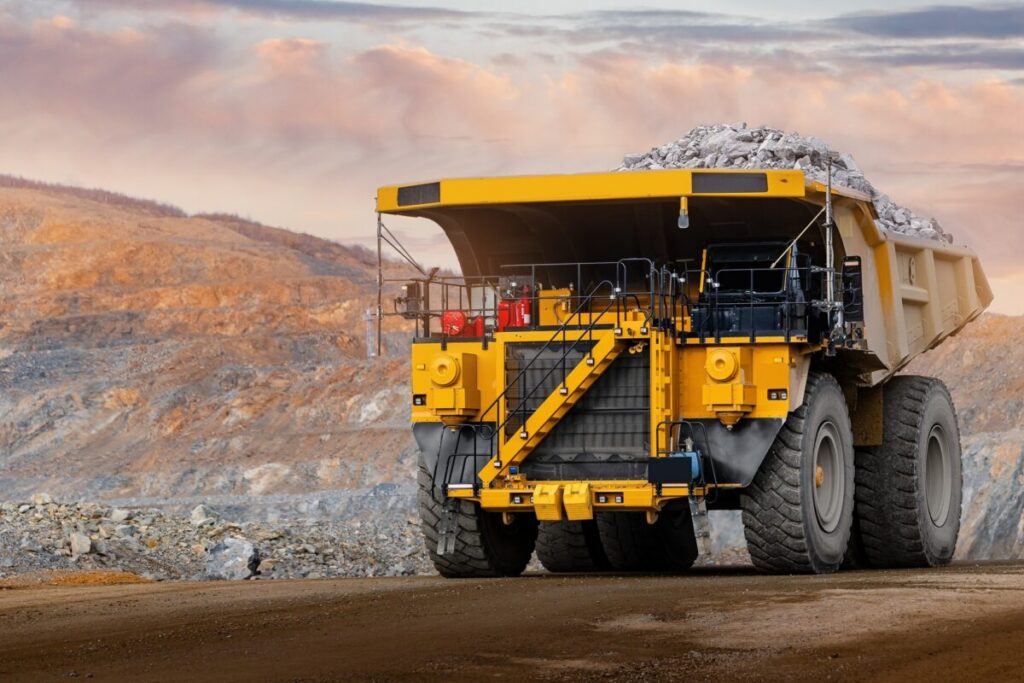
Global uranium resources are sufficient to support the growth of nuclear power beyond 2050. However, bringing these resources into production requires sustained investment in exploration and mining capacity starting now, warns the Red Book 2026.
There is no geological shortage of uranium on the horizon to 2050, despite the strong revival of nuclear power worldwide. This is the main finding of the 2026 edition of Uranium: Resources, Production and Demand, published on 14 September by the OECD Nuclear Energy Agency (NEA) and the International Atomic Energy Agency (IAEA). Better known as the “Red Book”, the publication has been the global reference on uranium resources, production and requirements for several decades.
This 31st edition brings together data from 46 uranium-producing or consuming countries. It identifies more than 8.1 million tonnes of uranium recoverable at costs below USD 260/kgU, equivalent to USD 100/lb U₃O₈, the main component of yellowcake. This volume is 2.1 % higher than in the previous edition.
“Sufficient uranium resources exist to meet nuclear power requirements in both low- and high-growth scenarios through 2050 and beyond,” the authors state.
Demand could more than double by 2050
As of 1 January 2025, the global nuclear fleet comprised 418 reactors in commercial operation, representing an installed capacity of 378 GWe. Their annual requirements were estimated at around 64,500 tonnes of natural uranium.
By 2050, the gap between the two scenarios considered is substantial. Under the low case, global nuclear capacity would increase by around 42 %, with annual uranium requirements reaching 84,800 tonnes. Under the high case, installed capacity would increase by a factor of around 2.3, with demand rising to 143,900 tonnes per year.
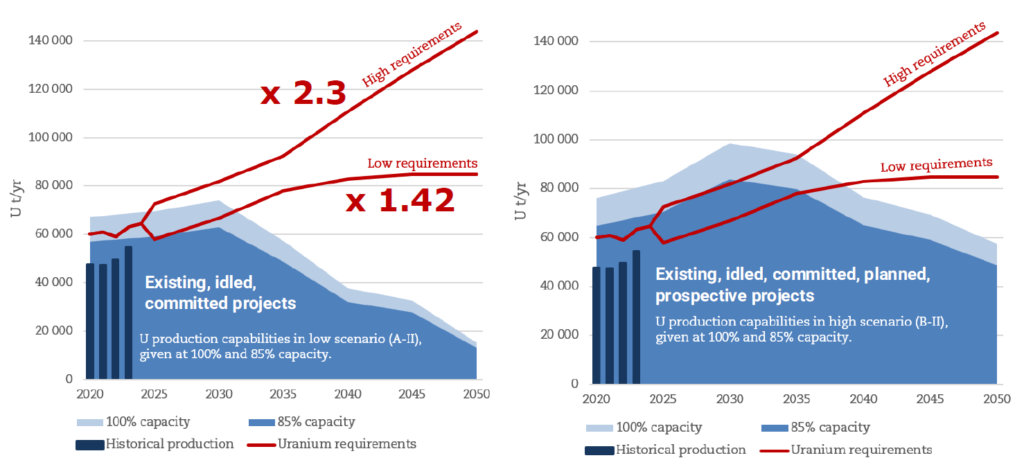
Uranium requirements are expected to increase by a factor of 1.42 to 2.3 by 2050. – Source: NEA-IAEA, “Uranium 2026: Resources, Production and Demand”, 31st edition.
The Red Book also extends its analysis beyond 2050. Assuming nuclear capacity subsequently stabilises, cumulative demand could exceed the 8.1 million tonnes of currently identified resources in the 2080s under the high case and in the 2120s under the low case.
However, these dates should not be interpreted as uranium depletion dates. “Identified” resources do not constitute a fixed inventory: they evolve with exploration programmes, geological knowledge, extraction technologies and economic conditions. When prices and market prospects become favourable, investment increases and new resources can be discovered or reclassified as recoverable.
The return of mine production
After a decade of slowdown, the global uranium market began to recover from 2021. The spot price rose from around USD 30/lb U₃O₈ at the beginning of that year to a peak of USD 106 in January 2024. Despite some volatility since then, prices remain structurally above the levels observed before 2021.
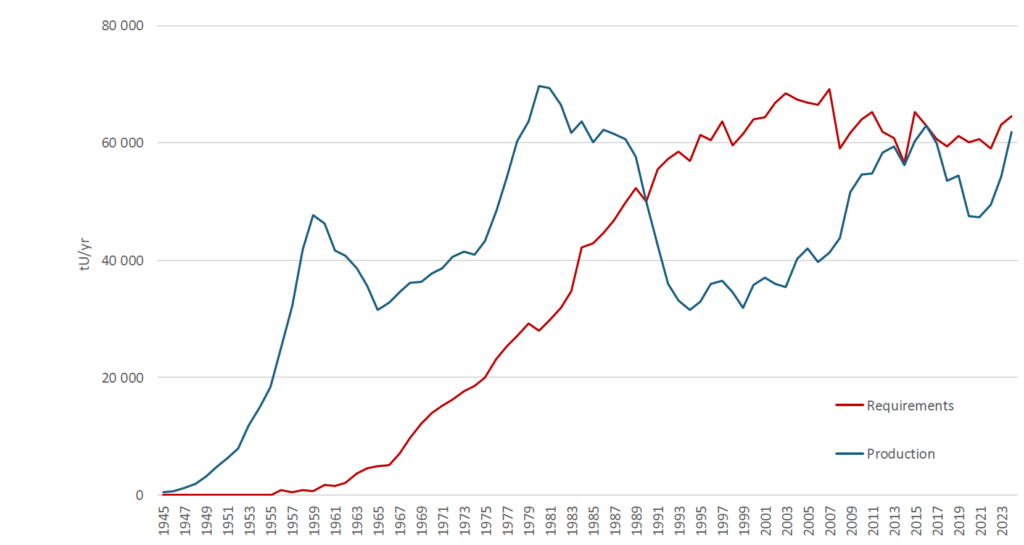
Global uranium production and requirements – Source: Ibid.
This trend is beginning to have industrial effects. Global uranium production increased by around 20 % in 2023 and 2024 compared with the previous two years, exceeding a cumulative 116,000 tonnes. With 61,924 tonnes produced in 2024, the sector recorded its highest level since 2016. Mine production in 2024 therefore represented nearly 96 % of current annual reactor requirements. However, market balance continues to rely partly on other sources: previously accumulated inventories, uranium from reprocessing, material from dismantled weapons, or the re-enrichment of depleted uranium.
The rise in prices has also revived exploration. Global expenditure on the search for new deposits and project development exceeded USD 1.78 billion in 2023 and 2024, an increase of around 46 % compared with the 2021-2022 period. Several projects that had previously been suspended are now moving closer to a final investment decision, particularly in North America.
From resource availability to production
“However, resource availability alone does not guarantee security of supply,” the authors warn. Many years can pass between the identification of a deposit and the delivery of the uranium required for fuel fabrication. The NEA notes that this can take fifteen to twenty years.
Project feasibility also depends on the political stability of producing countries, national mining policies, local acceptance and available industrial experience. Abundant resources can therefore remain inaccessible for long periods if economic, regulatory or political conditions do not allow them to be developed.
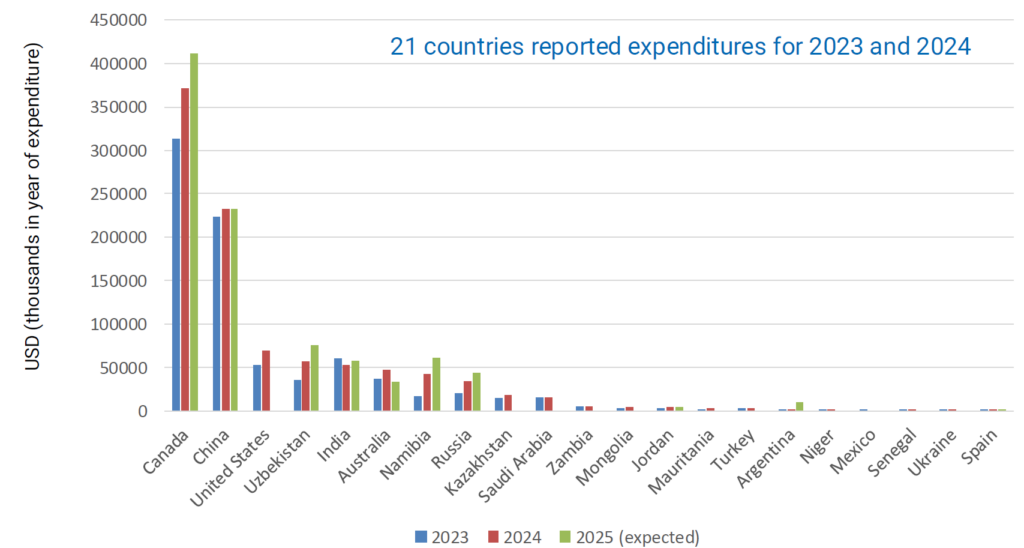
Exploration and development expenditure – Source: Ibid.
Prices and contracts to provide visibility
For the NEA and the IAEA, the challenge is to provide producers with the visibility needed to commit to major investments whose returns are measured over several decades. Prices that are too low or too uncertain delay not only the opening of mines, but also the exploration on which future supply will depend. “Price signals and long-term contracts are essential to support exploration and enable investment decisions in new mines,” they explain.
Finally, the Red Book notes that the projections are based primarily on the operation of current reactors and fuel cycles. “Advanced reactors and closed fuel cycles incorporating recycling could, if successfully developed, enable existing uranium resources to be used for at least several centuries, thereby ensuring the long-term sustainability of nuclear energy,” the authors state. It should be recalled that France has launched a programme aimed at closing the fuel cycle and eliminating the need for natural uranium imports by 2100. ■