
[Flamanville EPR] First Complete Inspection began on 26 September for 350 days
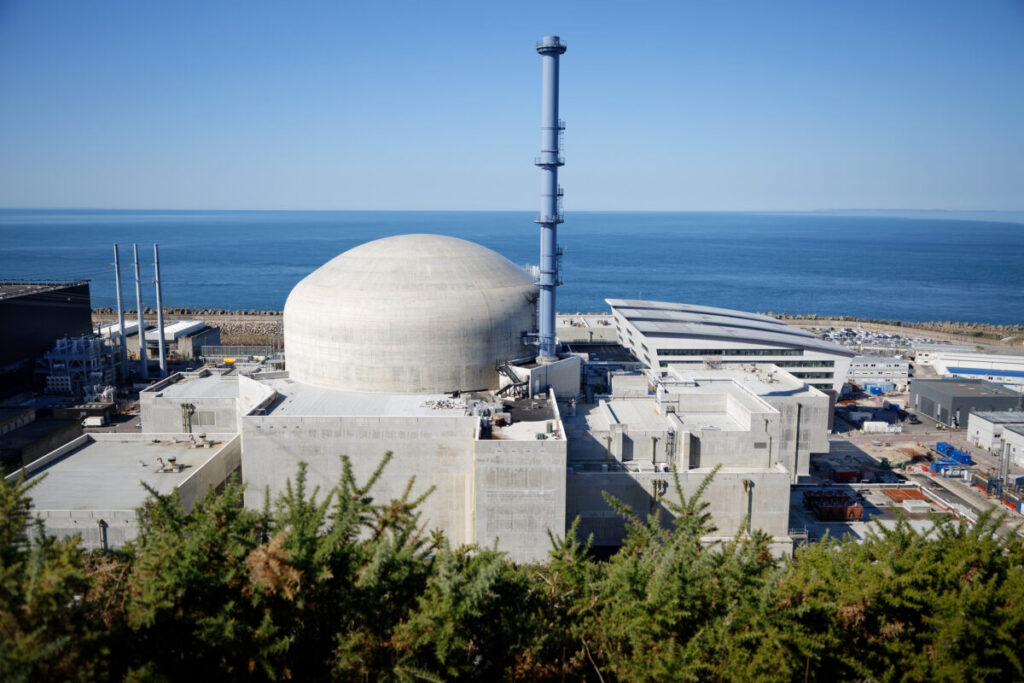
On Saturday 26 September, the Flamanville 3 reactor began its first Complete Inspection (VC1), the final major regulatory milestone before the EPR enters its normal operating cycle. The programme includes an in-depth inspection of the plant, regulatory tests and several equipment upgrades.
The Flamanville 3 EPR is operating well. More than that, it is delivering. Following the completion of the reactor’s start-up tests on 27 April 2026, the unit contributed fully to EDF’s electricity generation during an exceptionally hot summer. During five months of commercial operation, Flamanville 3 experienced only one nine-day outage, according to RTE data, “to carry out additional checks, as part of the preventive monitoring of operating parameters, on two of the four reactor coolant pumps”.
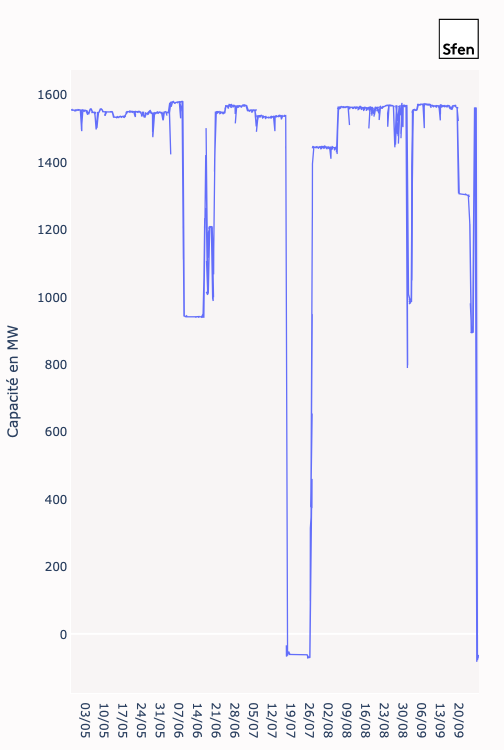
Flamanville 3 dispatched output between the end of start-up testing and VC1. Source: RTE
Since its connection to the French electricity grid in December 2024, France’s 57th reactor has generated 9.9 TWh of electricity. Its net electrical output reaches 1,600 MWe under normal operating conditions. “We have significantly exceeded the initial generation forecast of 7 TWh, thereby contributing fully to EDF’s annual targets of between 350 and 370 TWh per year,” said Renaud Crassous, Deputy Director for Performance at EDF’s Nuclear Generation Division, during a press conference on 22 September. “Flamanville 3 should reach 10 TWh before the start of its Complete Inspection on 26 September.”
Known as “VC1” in EDF terminology, this inspection represents the last major checkpoint for the reactor before it enters a routine operating cycle through to its first ten-year inspection. “VC1 is a major milestone in the life of a nuclear facility,” Cédric Lewandowski, EDF Group Senior Executive Vice-President, Nuclear and Thermal Generation, wrote on LinkedIn. “As the first scheduled outage following reactor start-up, it is both a regulatory requirement and a strategic opportunity to confirm the plant’s long-term robustness, safety and performance.”
24,000 hours of work
To carry out this programme, nothing has been left to chance: 20,000 activities will be performed over 350 days, at a cost of several hundred million euros. “All the valves will be inspected, representing 24,000 hours of work,” the Deputy Director of the Nuclear Generation Division gives as an example. “In total, up to 2,500 people will be mobilized on site, involving 200 partner companies.” Of these companies, 95 % are French, with 40 % of the activities being carried out by companies based in Normandy.
The EPR check-up includes several major regulatory inspections: a complete inspection of the reactor pressure vessel using a robot, a hydrostatic test of the reactor coolant system “at 206 bar compared with 155 bar during normal operation”, and a containment pressure test at 5 bar to verify its leaktightness. Many other operations are planned on other equipment to ensure its long-term integrity. At the same time, the unit will undergo several significant upgrades, including replacement of the reactor pressure vessel head, which arrived on site several months ago. “We will optimize the instrumentation and control systems and replace the heat exchangers in the component cooling water system,” Renaud Crassous added.
Efficiency as the guiding principle
“The Complete Inspection is not specific to Flamanville 3; it has been planned for a long time,” the EDF representative explained. “We have been preparing intensively for this milestone since the first fuel loading in May 2024.” That milestone also marked the beginning of a 30-month countdown leading up to the start of VC1.
“From that point onwards, we challenged the programme, established a schedule and prepared the teams in order to optimize the implementation timetable as much as possible,” he said. EDF also addressed logistics at regional level to facilitate transport and accommodation for its teams. “We are calling on EDF personnel from other facilities to pool expertise,” Renaud Crassous noted. “We will also benefit from the experience gained through the Start 2025 programme, which is now entering its second phase.”
The most recent equivalent inspections, carried out at Civaux and Chooz, lasted between 190 and 200 days. “This difference is explained by the greater complexity of the EPR design and more prescriptive regulatory developments, which naturally involve more operations,” Renaud Crassous explained. If the schedule is maintained, the EPR is expected to resume supplying electricity to the grid on 11 September 2027. ■