
Mobilizing all of CEA’s R&D capabilities for the nuclear revival
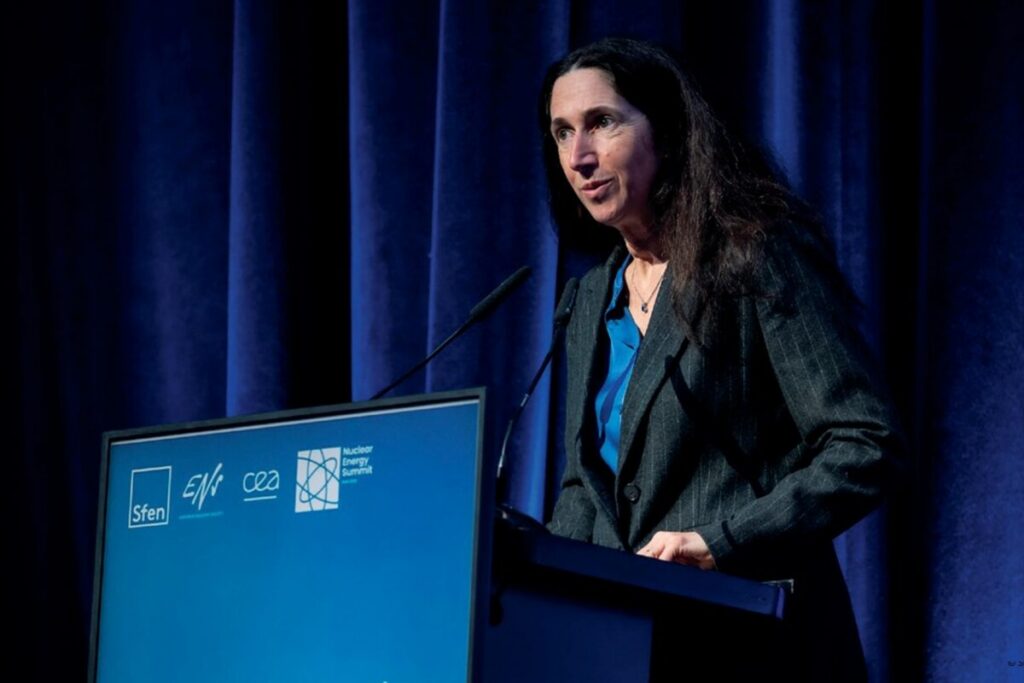
As France revives its nuclear programme and reaffirms its technological ambitions, CEA holds a strategic position at the heart of public policy. Anne-Isabelle Étienvre, Chairman of the CEA, discusses how the organisation’s scientific “crown jewels” are being mobilized to address the country’s energy challenges.
Note: This article was originally published in RGN 2026-2, Summer 2026, as part of the special feature “R&D supporting the nuclear revival”.
What is your assessment of your first year at the head of CEA, and what direction have you set?
My first year has confirmed to me that, at the age of 80, CEA once again finds itself at the heart of the major sovereignty, energy and technology challenges that led to its creation. The direction set today is clear and has been widely reaffirmed by the State. On the one hand, the President of the Republic’s speech at Île Longue on 2 March 2026 confirmed a strong ambition to strengthen France’s nuclear deterrent. On the other hand, the revival of civil nuclear power is a major structural component. Digital technologies are also a major priority, whether in semiconductors, quantum technologies or high-performance computing. For CEA employees, as well as for our academic and industrial partners, this strategic clarity is essential.
This has led to my intention to strengthen interactions between CEA’s civil and defence activities. We have therefore launched a mapping exercise for dual-use research in order to identify potential synergies more systematically between the organisation’s various divisions. The objective is to make better use of scientific, technological and industrial complementarities in support of CEA’s excellence, innovation and attractiveness. I have seen the commitment and high quality of our teams, which I had already observed in my previous positions.
What role should CEA play in the nuclear revival?
My ambition is for CEA to be fully involved in France’s nuclear team. This notably requires greater mobilization of all our R&D capabilities in support of the revival. With this in mind, we have launched an upstream research programme. It involves all CEA divisions and is intended to prepare the innovations and technological breakthroughs that the sector will need in the future.
I am also very pleased with the quality of our relations with EDF, Orano and Framatome. This ability to work together is a genuine asset, as few countries have such a comprehensive civil nuclear ecosystem. Closing the fuel cycle is a good example of this dynamic. Together, we developed a joint programme that was selected by the President of the Republic. The decision taken by the Nuclear Policy Council in March 2026 to entrust CEA with project ownership of this programme represents a major responsibility, the significance of which we fully recognize.
There has been a decline in ambition for nuclear R&D over recent decades. Can this delay be made up, or are we in a critical situation?
It is undeniable that, for several years, public policies showed more limited ambition for nuclear energy. This had consequences for investment and for innovation and research dynamics. France nevertheless succeeded over time in preserving strong capabilities in strategic areas. Since 2022, the nuclear revival has been clearly embraced and is taking place in an international context marked by growing recognition of its role in low-carbon energy generation. It was undoubtedly time to relaunch these activities before reaching a genuine point of vulnerability, but key expertise has been maintained, particularly in closing the fuel cycle and in sodium-cooled fast reactors. The challenge now is to scale up these capabilities in order to restore strong innovation momentum and reinforce France’s leadership. Finally, an important challenge remains at European level: ensuring that all technological components of nuclear energy R&D are eligible for European funding on the same basis as other low-carbon technologies.
At the Nuclear Energy Summit in March 2026, you referred to R&D facilities as “crown jewels”. What did you mean by that?
I meant that these facilities are both rare, valuable and irreplaceable. They represent a scientific and technological heritage on which a significant part of our capacity to innovate in nuclear energy depends. They are essential. They make it possible to study the behaviour of materials and fuels, test new technologies and, more broadly, ensure the scientific and technical robustness on which the entire nuclear sector relies.
I am thinking, of course, of the hot laboratories and experimental facilities at CEA centres, but also of the Jules Horowitz research Reactor. These infrastructures meet highly specific needs for both industry and the scientific community. There are very few of them in Europe, or indeed elsewhere in the world, and both their design and operation require highly specialized expertise. This is also why they are difficult to finance. They address niche requirements and rarely fit within conventional funding mechanisms, particularly at European level.
The Jules Horowitz Reactor (JHR) project experienced significant difficulties in the past. Do you believe it is now on the right trajectory and remains appropriately sized for the sector’s needs?
For several years now, we have returned to a controlled trajectory. The schedule has been stabilized, the cost at completion has been secured, and work is progressing in line with the objectives that have been set. In this respect, 2026 represents a particularly important milestone. Construction was around 50 % complete at the beginning of the year and we are aiming for close to 80 % by the end of the year. This represents major progress that will significantly reduce the risks associated with the construction phase, although caution naturally remains necessary until the reactor reaches first criticality, scheduled for 2032.
We are also entering a new phase of the project. The JHR remains a programme under construction, but we are now beginning to prepare for its operation. This means anticipating future scientific programmes, preparing experimental instruments, structuring partnerships and organizing the reactor’s future uses. This momentum is also generating growing international interest. Several countries have expressed interest in the reactor, and some are even considering joining the consortium. Finally, I have no doubt about the relevance of the JHR in view of current and future needs. In a European landscape where many research infrastructures are ageing, the JHR will occupy a distinctive position.
Are industry players expressing their R&D needs clearly enough?
The exchanges are of good quality, and roadmaps are generally well shared among the sector’s stakeholders. However, we are in a period of rapid acceleration. Industry needs are evolving quickly, as are our own capabilities, infrastructures and research programmes.
In this context, I believe it would be appropriate to reassess regularly, ideally every year, the sector’s needs and the resources collectively available to address them. This review would make it possible to ensure that we maintain the right level of complementarity between the different stakeholders and that we make the best possible use of our research and innovation resources.
CEA has historically been a major player in fusion research. What role does this technology now play in your research and innovation strategy?
Fusion is currently attracting considerable interest worldwide, and I believe it is important for France to clarify its position in this field. We need to be realistic about the technology’s level of maturity. Fusion remains a long-term research field. Nevertheless, France has recognized strengths in both magnetic confinement fusion, notably through the WEST (Tungsten (W) Environment in Steady-state Tokamak) facility at Cadarache, and inertial confinement fusion. Few countries can claim such a diverse range of capabilities. With this in mind, CEA has developed, together with its partners, a national strategy that has been submitted to the ministry responsible for research and is expected to be made public shortly.
How do you see the combination of experimental research and digital tools developing? Could R&D eventually become largely virtual?
I do not believe that we will ever be able to dispense entirely with comparing simulation with experimental reality. However, I am convinced that the combination of the two approaches will continue to grow. Digital tools already provide considerable benefits. They make it possible to explore a large number of configurations more rapidly, cover much broader parameter spaces and guide experimental programmes more effectively. In this respect, they are a powerful accelerator for research and innovation.
But at some point, models must always be confronted with reality. Experimentation remains essential to validate hypotheses, qualify results and deepen our understanding of physical phenomena. This mechanism has long existed in scientific research: a continuous dialogue between simulation and experiment. Experimental data improve models, while models guide subsequent experiments.
What role does artificial intelligence play in your activities?
As in society as a whole, artificial intelligence is playing an increasingly important role. This development concerns both its general-purpose uses and much more specialized applications for scientific and technological research. Both dimensions are now fully present in our activities, which also include AI research aimed at developing frugal, embedded and trustworthy AI. Nevertheless, this development must be accompanied by constant vigilance. Hallucinations, biases and difficulties in interpreting certain results mean that a critical perspective must be maintained when using these technologies. We must take advantage of the opportunities offered by AI, but do so with discernment, always keeping in mind that these tools replace neither scientific expertise nor human judgement. ■
Interview by Ludovic Dupin, Sfen
Image:
Anne-Isabelle Étienvre, Chairman of the CEA, at the international conference “What R&D Infrastructure to Support the Nuclear Revival?” organized by Sfen in March 2026. – @Sfen