
[Nuclear by the Numbers] 17 debates and consultations in 22 years to include nuclear power in democratic debate
Through its “Nuclear in figures” series, RGN examines the sector’s major trends through key data. Contrary to the idea that citizens are excluded from nuclear-related decisions, the French framework provides for several forms of public participation, from the earliest stages of project development through to the monitoring of facilities in operation.
“When it comes to nuclear power, one of the main shortcomings is democratic debate,” Green MP Sandrine Rousseau said in May 2026 on the programme Questions politiques. This criticism, frequently voiced by opponents of nuclear power, should nevertheless be considered in light of the mechanisms already in place.
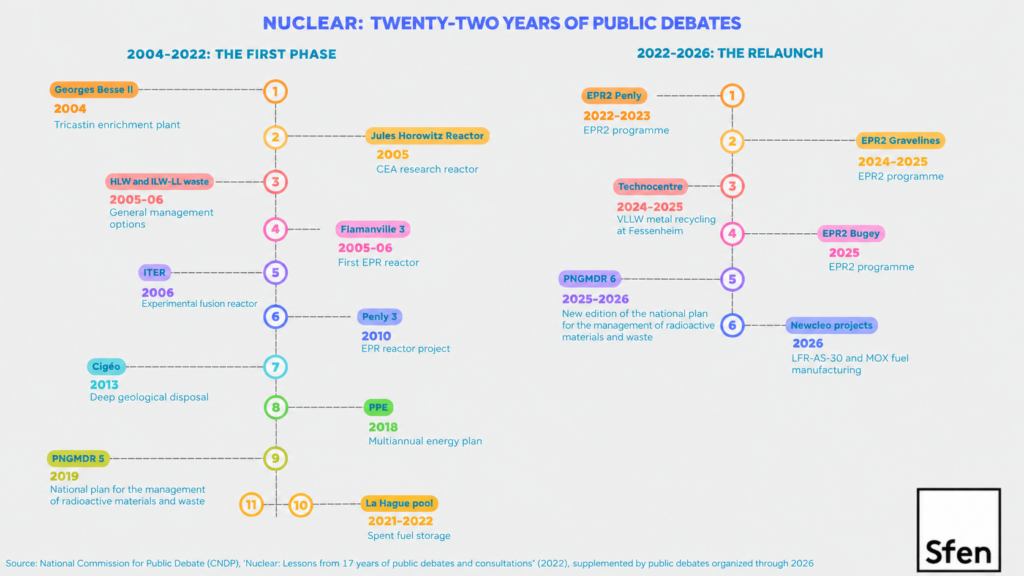
According to data from the French National Commission for Public Debate (CNDP), between 2004 and 2022 France organised, in relation to civil nuclear power, “11 public debates and consultations on projects, plans or programmes concerning civil nuclear power, and one debate on a nuclear facility (the Technocentre project for the recovery of very low-level radioactive metals at Fessenheim)”.
Since that publication, six new procedures have concerned the EPR2 programme and its first deployment at Penly, the EPR2 projects at Gravelines and Bugey, the Fessenheim Technocentre, the sixth edition of the French National Plan for the Management of Radioactive Materials and Waste (PNGMDR), and Newcleo’s reactor and fuel fabrication plant projects. These debates are supplemented by numerous public inquiries, including, for example, the one concerning the application for authorisation to create Cigéo, held from 18 May to 2 July 2026.
Public debate, the first stage of any project
Public debate is the first major stage of citizen participation. Organised at a very early stage of a project, it takes place before an authorisation application is even submitted. It enables discussion of whether the project itself is appropriate, as well as its objectives, characteristics and possible alternatives.
Public participation in decisions that have an impact on the environment is a constitutionally guaranteed right under Article 7 of the French Charter for the Environment: “everyone has the right (…) to participate in the preparation of public decisions having an impact on the environment”. Nuclear power is no exception: citizens, associations, local elected representatives, experts and economic stakeholders can contribute to the development of projects.
The public inquiry: examining the project in detail
The most significant nuclear projects are subsequently subject to an environmental assessment under the French Environmental Code. This procedure includes a public inquiry during which citizens can consult the full project file and submit their comments. The documents made available include the environmental impact assessment, an analysis of identified risks and the measures envisaged to prevent or reduce them. Basic nuclear installations (BNIs) and decommissioning operations are subject to this stage.
The contributions received are analysed by the public inquiry commissioner and incorporated into the review of the application before the State issues its decision.
Public consultations: contributing online
When the law does not provide for a public inquiry, individuals and legal entities can still submit comments if the projects have a direct and significant impact on the environment. The documents are then published on the website of the French Authority for Nuclear Safety and Radiation Protection (ASNR), allowing anyone to submit comments online. The consultation lasts at least 21 days for regulatory decisions and 15 days for individual decisions.
Local committees to provide information to the general public
Public participation does not end once authorisations have been granted. Around nuclear facilities, it continues throughout their operation and up to their decommissioning through Local Information Committees (CLIs). France currently has 35 CLIs, brought together within the National Association of Local Information Committees and Commissions (ANCCLI). Located near nuclear sites, they act as an interface between operators, ASNR, elected representatives, associations and local residents.
“One of the essential missions of the CLIs is to provide information to the general public and thus enable citizens to form their own opinion on nuclear power,” ANCCLI stresses.
The CLIs can question operators such as EDF, Orano, the CEA and Andra, as well as ASNR. They also organise meetings and public debates, conduct or commission independent analyses, monitor the environment, and can call on experts or participate in certain inspections. ■