
Otrera and Hexana establish themselves in the historic territories of the French nuclear sector
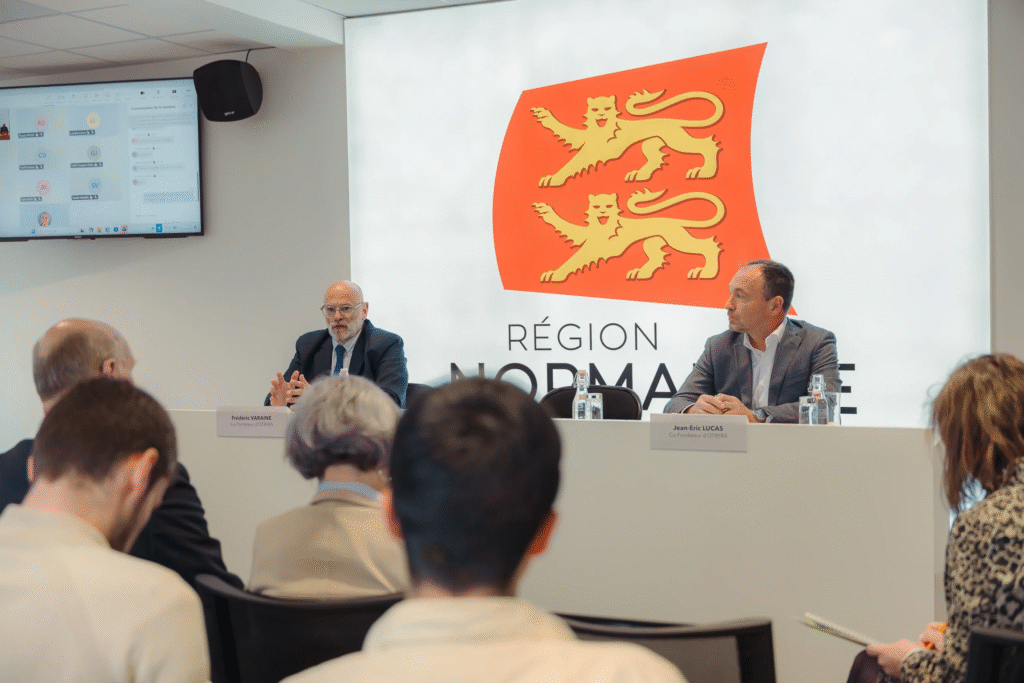
SMR developers Otrera and Hexana announced development plans in early April. While the former is launching siting studies in the Rhône Gard area for its first-of-a-kind unit, the latter has selected a site for a factory and a technology hub near Cherbourg.
After a period of slowdown, the French small modular reactor sector is regaining momentum. The announcements made at the Nuclear Policy Council in March 2026 have revived a dynamic from which developers are now seeing the first results. Following positive developments from Jimmy, Calogena and Newcleo, Otrera and Hexana are now presenting their progress.
Otrera has chosen the Normandy region for the location of an industrial facility, combined with a technology hub. Located in the municipality of Les Pieux, near Cherbourg, this geographical area allows the start-up to rely on a strong nuclear ecosystem. Close to the site, there are several Orano facilities, including the La Hague reprocessing plant, as well as sites in Beaumont, Saint-Sauveur and Valognes. A few kilometres away is also the Flamanville nuclear power plant.
Normandy momentum
The region has supported the development of the project from its early stages through various actions: site identification, strategic support, financial backing and equity participation. “In addition to the strong Cherbourg ecosystem, a key factor was the support of the Region through its Normandie Participation fund,” explains Frédéric Varain, President of Otrera, to RGN. The total cost is estimated at €50 million for the building and equipment. For the region, hosting this facility also represents a social benefit, with 200 to 250 direct jobs and 350 to 400 additional induced jobs in the medium term.
Several locations had been considered for Otrera’s development, but “the Les Pieux site appears to be the one that can be industrialised most quickly,” the founder adds. Time is a key factor that Otrera does not overlook. The company has established an ambitious timeline: “Broadly speaking, we aim to start construction on site in 2027, receive the first equipment in 2028, and begin operations on reactor components in 2029,” outlines Frédéric Varain. The Les Pieux site will host a manufacturing facility for key reactor components, such as pumps, vessels, control rods and heat exchangers, as well as a technology hub for testing these same components.
Industrial progress
“Initially, the plant will also serve as an assembly workshop, with the integration of components. The idea is also to enable testing at the factory, particularly on the transportable reactor module,” notes Frédéric Varain. “The reactor will operate at temperatures around 500 to 550°C, so the objective is to test complete loops at the plant, in order to reduce the need for demonstration once the reactor is fully assembled.”
Currently, the reactor design developed by Otrera is at the stage of preparatory review of technical exchanges with the Nuclear Safety and Radiation Protection Authority (ASNR). Regulatory work is expected to progress quickly: “We have a formal closing meeting on 15 April, and we intend to submit the application for the pre-licensing review of safety options at the beginning of May,” adds Frédéric Varain. The first demonstration unit is expected to be commissioned in 2032 at a separate site, with Otrera notably considering a location at the CEA site in Marcoule.
A regional initiative
For its part, Hexana has announced the launch of siting studies for the construction of its first SMR. It will be located in the Gard Rhodanien metropolitan area. “The objective is to begin the industrialisation phase in the second half of 2026, which will include the implementation of experimental facilities for qualification and scheduled testing,” explains Sylvain Nizou, co-founder and President of Hexana, to RGN. The company plans to start construction of its first-of-a-kind unit in 2031, with operation beginning in 2035.
The Bagnols-sur-Cèze economic area offers several advantages to the start-up spun out of the CEA. First, it hosts several energy-intensive and heat-consuming industries that represent potential customers for Hexana. “Our reactor will be able to be connected to the grid as well as to various hydrogen production systems, an energy vector in which the region is very dynamic,” specifies Sylvain Nizou. Beyond market opportunities, the energy ambitions of the South-East region are a major asset. “Local and regional objectives place the nuclear industry as a priority. Stakeholders in the region provide us with valuable support in our siting strategy,” he continues.
Back to roots
While the construction of the SMR is expected to mobilise around 2,000 people at peak activity, Hexana will create between 150 and 200 permanent direct jobs over the targeted 80 years of operation. As with Otrera in Normandy, Hexana can rely on a well-established nuclear ecosystem in the Gard region, including the CEA site in Marcoule, as well as organisations such as Cyclium and Le Collectif. “It is a historic region of the French nuclear sector, and even more so for sodium-cooled fast reactors,” comments Sylvain Nizou.
In addition to its siting work, Hexana is progressing on other technical and regulatory aspects. Currently in the preparatory review phase of technical exchanges with the ASNR, the SMR project is expected to enter the licensing phase at the end of 2026, with the submission of the safety options file. At the same time, Hexana will contribute to the fuel cycle closure programme announced at the Nuclear Policy Council in March 2026. “The government has expanded its support for SMRs and the nuclear sector during the CPN,” explains Sylvain Nizou. “After being selected under the France 2030 call for projects, Hexana is continuing its development with a priority on commercial growth through mainly private funding, in line with the national framework for the revival of sodium fast reactors.” ■