
Flamanville: the EPR validates islanding at full power
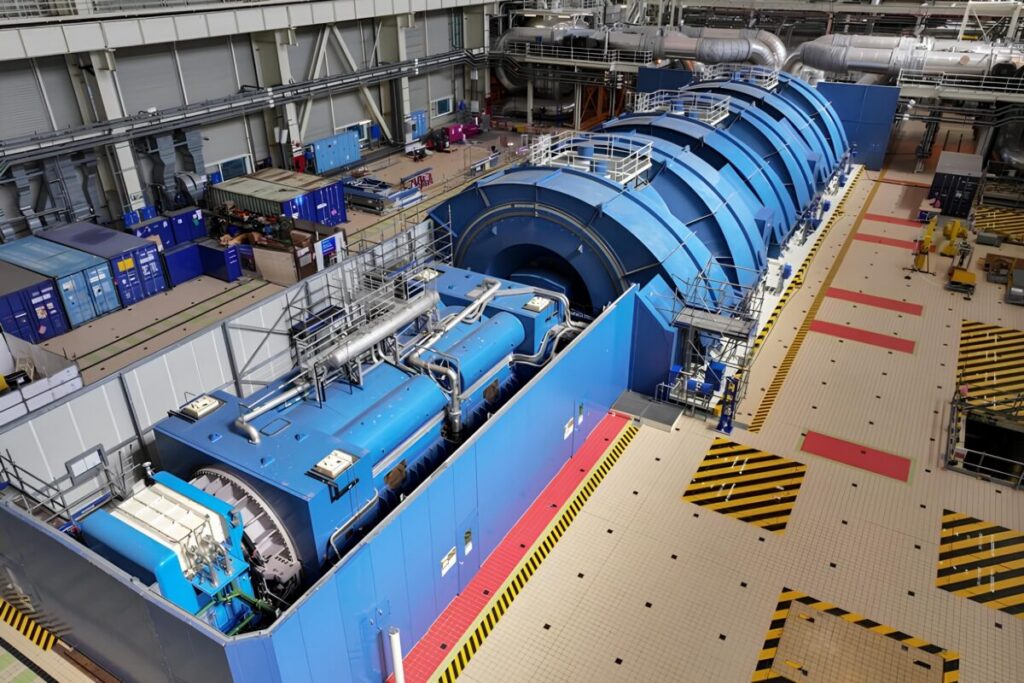
With the successful completion of its full-power islanding test, the Flamanville EPR is entering the final stage of its commissioning test phase. The first Generation III reactor of the French nuclear fleet could thus move into an operational phase in the coming weeks, ahead of its first scheduled outage in September 2026.
Since the Flamanville EPR reached full power in December 2025, the reactor has been undergoing a series of tests to complete the commissioning phase of its gradual start-up. Under the supervision of the Nuclear Safety and Radiation Protection Authority (ASNR), a major milestone was reached on Friday 27 March at 10:10 a.m. with the completion of the full-power islanding test. This sequence aims to verify the plant’s ability to supply its own power after disconnection from the national electricity grid. “The islanding test proceeded well and met expectations. This test demonstrates that even when disconnected from the grid, the installation can independently supply its essential systems, a key safety feature,” EDF told RGN.
What happens for the EPR
During disconnection, reactor power decreases within a few minutes from 100% to around 25%. The plant nevertheless continues to generate energy at a level sufficient to cover its own needs. Heat from the core continues to drive the turbine-generator set, which produces approximately 90 MWe required for internal safety systems (pumps, control systems, auxiliaries). This autonomous operating mode was maintained for just over three hours.
The disconnection itself is relatively “simple”: the teams opened the circuit breaker connecting the EPR to the grid. However, the main challenge of the test lies in what happens in the following hours. “It is the two hours that follow which are essential to observe how all systems stabilise,” explains Sébastien Frand, engineer in charge of the test at EDF. The few hours of testing also required several weeks of preparation to ensure that all operators acted in a coordinated manner during the event. The teams therefore carried out upstream “a detailed risk analysis, a rehearsal of the test on a simulator, and a briefing involving all teams from operations, testing, the general technical division, metrology, Framatome, and Arabelle Solutions.”
A few tests remaining
At the same time, the turbine was tested several times at full power to assess the performance and responsiveness of the control systems, as indicated by Arabelle Solutions. The turbine-generator set was also given particular attention during the islanding test. A turbine trip test — simulating a sudden shutdown — was also carried out in early March to verify steam management under this transient configuration.
“With this islanding test, the EPR has just completed its final major test at full power,” EDF told RGN. Final tests will verify how the installation behaves when it no longer has access to certain equipment. “The next milestones will now focus on loss-of-equipment tests, scheduled in April, as well as tests on reactive power supply and absorption, which are essential for grid voltage control.” Only after these final operations will the EPR be able to complete its commissioning test phase and therefore enter full operational service. “Following the fallback tests, the EPR will enter a new phase: stable and continuous production operation until the VC1 outage scheduled for 26 September 2026,” EDF explains. ■