
RTE review: seven indicators from a record-breaking, low-carbon and export-driven half-year
Record-high generation, more than 95% low-carbon electricity, historic exports, prices among the most competitive in Europe… The review published by RTE confirms the remarkable recovery of the French power system. A look back at seven key points that sum up the first half of 2026.
The publication has become an unmissable event for energy-sector stakeholders. With the release of its electricity review for the first half of 2026, RTE presents a particularly favourable assessment of the French power system. Despite three heatwaves, a slight increase in consumption and persistently tense geopolitical conditions, France surpassed several of its previous records, including for electricity generation, the share of low-carbon generation, exports and price competitiveness.
-
Electricity generation reaches an unprecedented level
French electricity generation has broken records both in terms of volume and the share of low-carbon generation. “French electricity generation across all sources amounted to 284.3 TWh in the first half of 2026,” RTE emphasises. This represents an increase of 12.5 TWh, or 4.6%, compared with the first half of 2025.
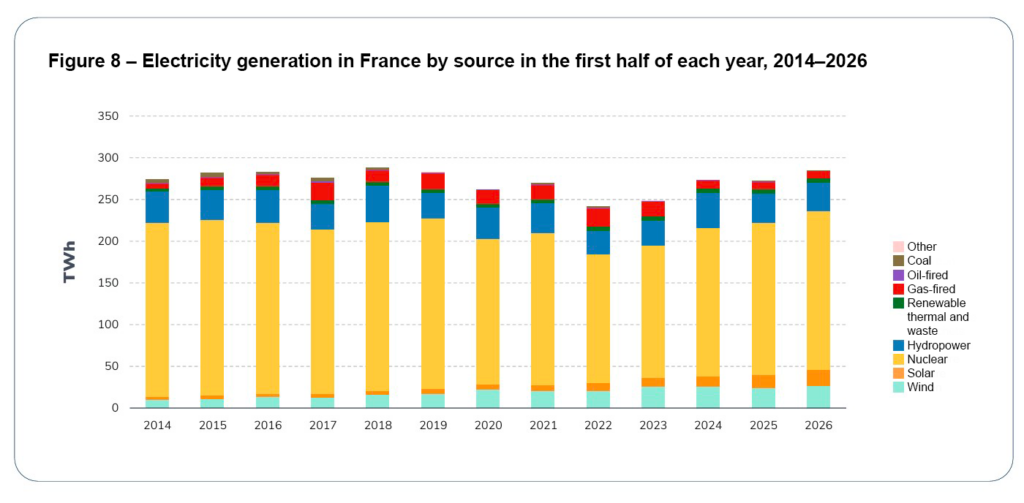
Nuclear, wind and solar power were the main drivers of growth in French electricity generation. Nuclear power alone increased by 7.9 TWh, ahead of wind power (+3.2 TWh) and solar power (+2.8 TWh).
The Flamanville EPR accounted for more than half of the increase in nuclear generation (+4.5 TWh). Since reaching full power in December 2025, its contribution has been complemented by improved availability across the rest of the nuclear fleet, which rose from 73.0% in the first half of 2025 to 73.9% one year later.
-
The power mix reaches a historic low-carbon share of 95.2%
“The share of low-carbon generation reached a historically high level for a first half-year, at 95.2%,” RTE notes. Direct emissions associated with electricity generation amounted to 4.9 MtCO₂e in the first half of 2026, down 9.1% compared with the first half of 2025 and continuing a downward trend that began in 2023.
-
French electricity exports reach new highs
France set a new electricity export record in the first half of 2026, as RGN had previously reported. With 51 TWh of net exports, France established a new record for a first half-year. This result was well above the previous records set in the first halves of 2024 (43 TWh) and 2025 (38 TWh).
Over the period, net exports to neighbouring European countries averaged 11.7 GW, “equivalent to the output of around 12 nuclear reactors”, according to RTE.
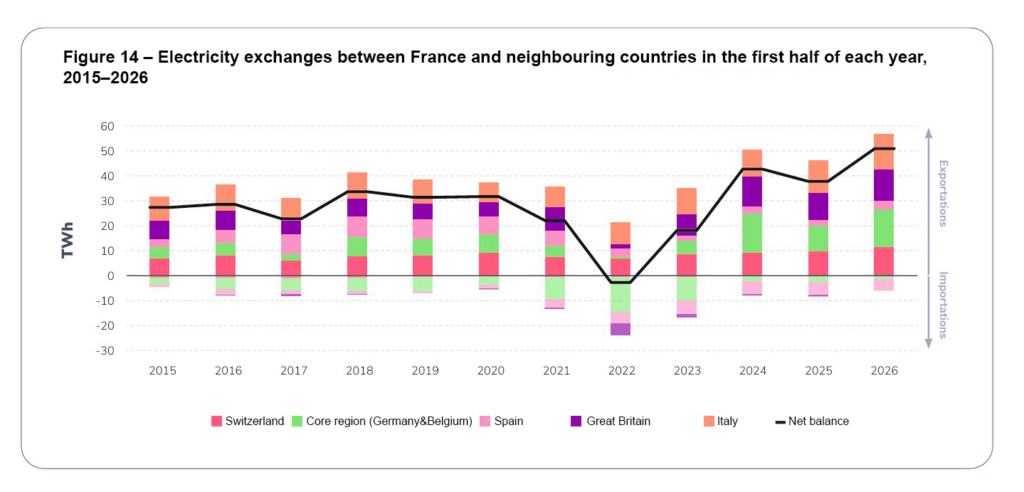
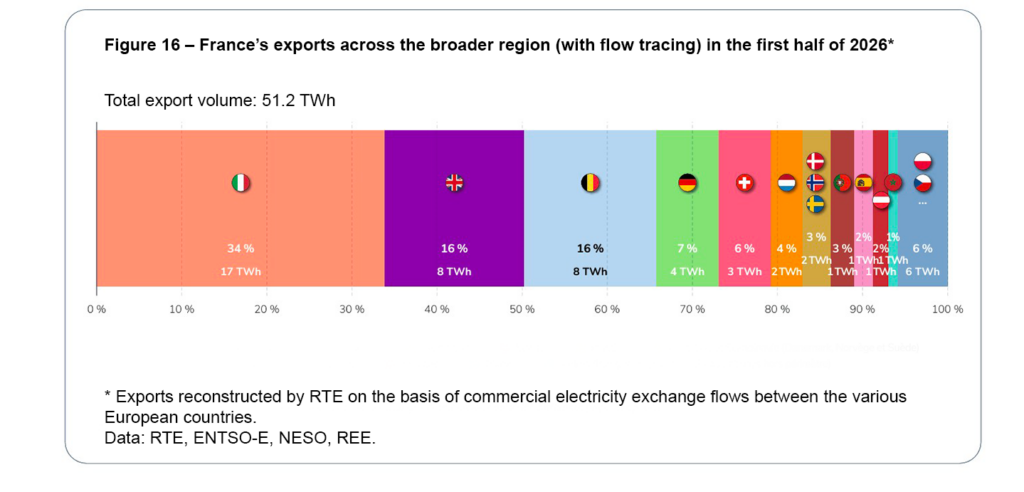
Driven by historically high export volumes, net electricity exports generated a record value of €3 billion in the first half of 2026, €600 million more than one year earlier, RTE emphasises.
-
Consumption increases slightly
“Consumption adjusted for weather and calendar effects (see focus below) increased slightly (+2.2 TWh, or +1%) to reach 230.6 TWh during the first half of 2026¹, compared with 228.4 TWh over the same period in 2025,” RTE explains. This increase was due both to the connection of large industrial facilities to the transmission network (+1.9%) and to the residential sector (+1.6%).
However, consumption remained 5.7% below its average level between 2014 and 2019. “At this stage, it is not possible to conclude that a structural shift from fossil fuels to electricity is under way,” the transmission system operator notes.
-
Nuclear load-following volumes decreased
The nuclear fleet carried out less load-following during the first half of 2026: the volume of foregone generation was limited to 10 TWh, compared with 15 to 20 TWh one year earlier. At the same time, its technical minimum—that is, the minimum output at which it can operate under normal conditions—increased by 4 GW to an average of 36.6 GW. This development reduced its theoretical ability to lower output further, although this technical minimum remained within the range observed over the past ten years. Average nuclear generation stood at 43.7 GW.
-
French electricity prices shielded from geopolitical crises
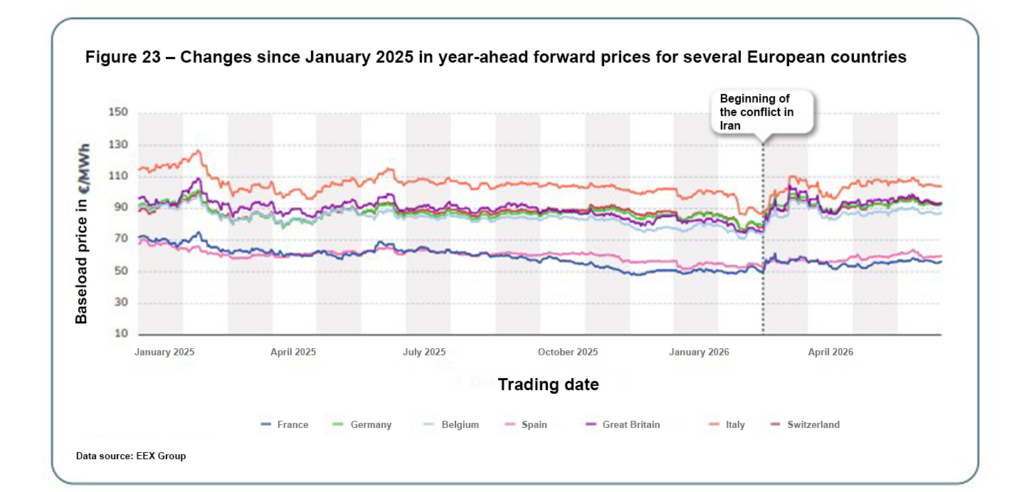
“Day-ahead spot electricity prices decreased slightly in the first half of 2026 compared with the first half of 2025,” RTE reports. Despite tense international conditions, the French electricity market remained relatively insulated. Thanks to abundant low-carbon generation in the spring, particularly from nuclear power and renewables, electricity prices in France remained less sensitive to fluctuations in gas prices, except during periods of high demand.
France benefits from some of the most competitive spot prices in Europe. “The average French price during the first half-year was around €30 lower than the average German price (€98.7/MWh) and Belgian price (€95/MWh), with an even wider gap compared with the British price (€107/MWh, or +€45.1/MWh), the Swiss price (€111.3/MWh, or +€49.40/MWh) and the Italian price (€128.7/MWh, or +€66.8/MWh),” the transmission system operator explains.
-
But an increase in negative prices
The number of hours during which spot electricity prices were negative continued to rise. In the first half of 2026, this occurred during 407 hours, or almost one hour in ten, compared with 363 hours over the same period in 2025. By comparison, 513 hours of negative prices were recorded over the whole of 2025.
The transmission system operator draws a very positive conclusion: “The competitiveness of the French power mix, resulting from abundant low-carbon generation with low variable costs, provides protection against crises affecting fossil fuel prices and constitutes a considerable asset for decarbonising the economy and accommodating new uses.” ■
By Floriane JACQ, Sfen
Image: France, Île-de-France, Paris, La Défense, RTE © PHILIPPE TURPIN / PHOTONONSTOP / PHOTONONSTOP VIA AFP