
[2027 French presidential election] At the UFE conference, France’s major parties set out their positions on nuclear power
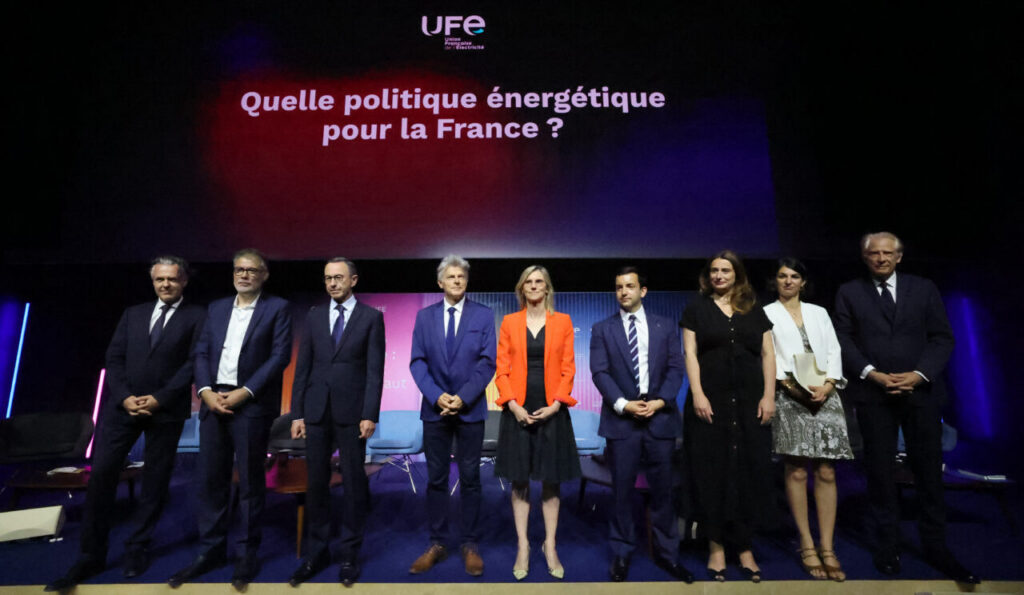
One year ahead of the 2027 French presidential election, France’s main political parties, across the political spectrum, are beginning to clarify their vision for energy policy. At a conference organised by the UFE, their representatives presented their initial orientations. While all are banking on the growing electrification of end uses, deep differences remain over the role nuclear power should play.
At the conference of the Union Française de l’Electricité (UFE), on Tuesday 23 June, the major political parties whose candidates have been announced or are expected for the 2027 French presidential election set out the broad lines of their energy plans. While the massive electrification of the country emerges as a shared ambition across all programmes, it is on how to achieve this objective that the political parties differ. From massive development to a planned phase-out of nuclear power, an overview, in alphabetical order, of the first policy directions of the political parties.
Christophe Béchu (centre-right, Horizons): “Three pillars: nuclear, renewables and Europe”
Christophe Béchu, mayor of Angers and secretary general of Edouard Philippe’s political party Horizons, embraced “continuity with Emmanuel Macron’s policy”. But he also says that “new fields are being explored”. “Nuclear power is an incredible opportunity, enabling us to have an asset base that produces decarbonised energy, but where we face challenges in extending the life of power plants and investing in new nuclear,” he said. On renewables, described as “essential complements”, the former Minister for the Ecological Transition said that “an acceleration on storage and flexibility is essential”. Another difference with Emmanuel Macron is the desire to “benefit from a single strategy for 2050 that merges the Multiannual Energy Programme (PPE), the National Low-Carbon Strategy (SNBC) and the National Climate Change Adaptation Plan (Pnacc). In addition to giving stakeholders visibility, this responds to a reality: we can no longer separate what falls under adaptation from what falls under mitigation.”
Olivier Faure (centre-left Socialist Party, PS): “Nuclear as much as necessary, renewables as much as possible”
“You cannot say that you want fully sovereign energy and, at the same time, stake everything on the nuclear horse,” said Olivier Faure, first secretary of the Socialist Party. While the MP for Seine-et-Marne has no reluctance to talk about nuclear power, and proposes developing it, he is scaling back the ambitions of the current government. “I would certainly not continue the construction of the same number of EPRs proposed by the government. The outlook is rather for two to four EPR2s.” This retreat is justified, according to him, by three reasons: the issue of waste treatment; sovereignty issues, since “there has been no uranium mining in France since 2001” and France remains partly dependent for uranium enrichment (1); finally, the difficulty of exporting these technologies. Olivier Faure highlighted EDF’s difficulties in winning European tenders, as well as stalled discussions in India. Nevertheless, “I believe that we must have enough nuclear power to avoid a French-style shutdown, but in parallel we must continue to make every possible effort in the renewables sector”.
Bruno Retailleau (conservative, Les Républicains, LR): “Banking on the asset we have: nuclear power”
The president of Les Républicains, Bruno Retailleau, wants to bank on “an extraordinary nuclear foundation”. “We are Europe’s electron granary and we have public and private flagships that the world envies. But for 15 years, these assets have been considerably weakened for ideological rather than scientific reasons,” said the senator for Vendée. He cited the closure of Fessenheim as an example: “it is the French people who are paying the cost.” Or the halt to the Astrid programme, which the candidate intends to relaunch in order to “make the circular economy of nuclear power a reality”.
Bruno Retailleau also made other commitments on nuclear power. First, “I am pushing the reactor lifetime trajectory as far as possible. I am continuing the EPR2 programme, starting with the first tranche of 6 reactors.” The candidate also wants to stop interconnection projects “because Europe wants us to absorb the intermittency of our neighbours with our nuclear fleet”. At the same time, the Les Républicains candidate wants to mobilise up to 4 GW of new hydropower capacity and end subsidies for renewable energies. The final objective: to double the share of electricity in the mix within 20 years.
Fabien Roussel (left-wing, French Communist Party, PCF): “We have a huge competitive advantage with nuclear electricity”
“The battle for the climate must not be set against improving the quality of life of our fellow citizens. That means establishing companies that need nuclear energy,” explained Fabien Roussel, national secretary of the French Communist Party. “Nuclear power gives France the possibility of multiplying the asset we already have today. We produce decarbonised, dispatchable and stable electricity; that is what our companies and the French people need.” In addition to advocating an increase in nuclear generation capacity, Fabien Roussel also wants to invest “in research, with support for the ITER project and the relaunch of the Astrid programme, but also to work on new-generation EPRs that will better manage heatwave periods and cooling needs.” At the same time, the PCF wants to leave the “speculative electricity market in order to regain the ability to set prices. With this strategy, we believe we can lower bills for households and businesses by 30 to 40%.” Enough to attract new industrial investment.
Agnès Pannier-Runacher (centrist, Renaissance): “Produce more, consume less and benefit from electricity overproduction”
For former Minister for the Energy Transition Agnès Pannier-Runacher, the candidate Gabriel Attal is fully in line with Emmanuel Macron’s policy. “We are an energy champion, whether renewable or nuclear. So our position is one of technological neutrality. What interests us is that they should be dispatchable, low-carbon and above all economically competitive.” Without expanding further on the nuclear issue, the MP for Pas-de-Calais mainly spoke about matters relating to the electricity market: the creation of new energy sectors, batteries, hydrogen, geothermal energy; the revision of peak/off-peak tariffs; the development of dispatchability for renewable generation assets; and vigilance on the European Union’s interconnection package.
Jean-Philippe Tanguy (far-right, Rassemblement National, RN): “A massively developed nuclear fleet”
While Jean-Philippe Tanguy, deputy chairman of the Rassemblement National group in the National Assembly, says he does “not bet on all-nuclear”, the atom represents one of the major pillars of his party’s energy policy. “Since we want to double the share of industry in French GDP by 2050, around 200 TWh of additional electricity will be needed. Hence the massively developed nuclear fleet. Namely, two construction programmes of five pairs of EPR2-equivalent units, and to move as quickly as possible to the 4th generation.” On this last point, the MP for Somme criticised the shutdown of Superphénix, which “cost France a 50-year lead and gave the advantage to China and Russia”. More broadly, on the electricity market, the RN wants to return to a position close to that which existed before market liberalisation. “France must take back control of its production, price-setting, and internal competition within the French market. EDF will regain full control of RTE and Enedis and, more generally, a simplification of the electricity market, which will be vertical.” Enough to reduce bills by one third for households and by one quarter for businesses.
Marine Tondelier (Green party, Les Ecologistes): “We therefore propose 100% renewables in the long term”
“For us, nuclear power is not a viable option, nor a credible alternative. It is too expensive and too slow to achieve carbon neutrality. The ERP2s will not be delivered before 2040 or 2050, whereas our Paris objectives are set for 2030 and Flamanville 3 was extremely delayed,” explained Marine Tondelier, national secretary of Europe, Ecologie, Les Verts. In addition to the scheduling issues surrounding the latest French nuclear project, the candidate believes that uranium is not compatible with a sovereign energy system: “Today, we do not import uranium from allied countries.” However, she added a word of caution: “We are fully aware that there is a cliff-edge effect, so if an ecologist reaches the presidency, we will not immediately close all the power plants. We will first have to deploy renewable energies as quickly as possible.”
Aurélie Trouvé (left-wing, La France Insoumise, LFI): “We believe that, in the long term, there must be a nuclear phase-out”
“We all share one objective: security of supply, which requires a long-term phase-out of fossil fuels, in order to be independent,” began Aurélie Trouvé, LFI MP for Seine-Saint-Denis. “This requires a massive electrification of our productive apparatus. We cannot leave decarbonisation in the hands of multinational shareholders, who do not trigger it in time or sufficiently.” To meet these electrification objectives, LFI intends to rely on renewable energies, “an area in which we have fallen far behind. We regret that there is not more ambition.” “We believe that, in the long term, there must be a nuclear phase-out,” she continued.
Dominique de Villepin (La France Humaniste): “A productive pact with the six EPR2s”
Former Prime Minister Dominique de Villepin did not dwell on measures concerning nuclear power, although he indicated his intention to continue the EPR2 programme. For the candidate, “we need to change method in order to stay on course for electrification”. “First, we must start from the bill. It is the bill that must govern our system. Having an electricity price that follows the price of gas is nonsense, when our electricity is produced essentially by nuclear power.” Dominique de Villepin therefore expanded on issues relating to the electricity market. On the agenda: the abolition of Energy Savings Certificates (CEE), the setting of a “fair price” for carbon, support for electrification through electric vehicles or heat pumps. Finally, the candidate called for the creation of a “territorial pact so that investments in electrical infrastructure benefit citizens”. ■
By Simon Philippe, Sfen
Image: MEHDI FEDOUACH / AFP
(1) Sfen and RGN have produced several pieces of work explaining that France has no dependency in terms of the fuel cycle.