
Georges Besse II: extension decree marks halfway point in the project
The decree authorising the increase in capacity at the Georges Besse II plant marks a ramp-up of France’s industrial tool. In the long term, Orano will increase its capacity to 10 million SWU, against the backdrop of a reshaping of the global enrichment market.
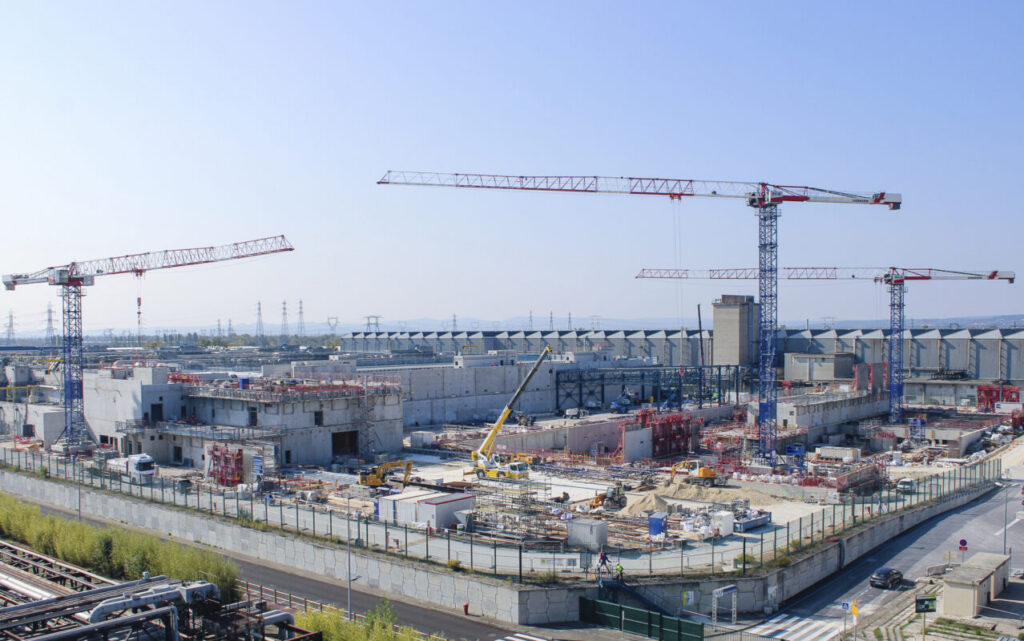
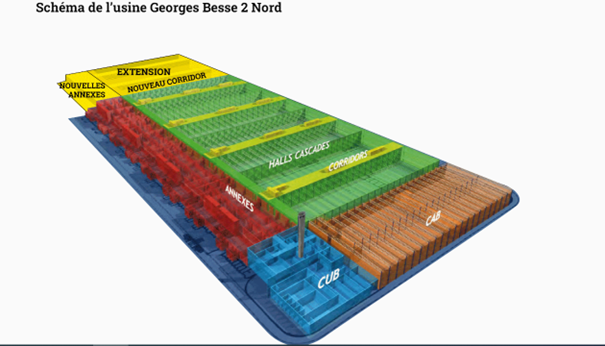
While the latest Nuclear Policy Council focused on the Back End of the Future programme, the front end of the fuel cycle has not been set aside. On 30 April, the Executive published the decree authorising the increase in capacity at the Georges Besse II enrichment plant, located on the Tricastin site. In line with the plan presented by Orano in 2023, the text confirms the creation of four new production modules in the northern part of the plant, which already has six. The southern part of Georges Besse II has eight enrichment modules.
The decree specifies that the extension project will ultimately allow the plant’s annual production to increase from 7.5 to 10 million SWU, an increase of nearly 30% compared with its current capacity. At the same time, the text recalls that “the first introduction of uranium hexafluoride into the northern extension is subject to the prior approval of the Nuclear Safety and Radiation Protection Authority.” In this context, Orano will have to submit a file to the ASNR one year before commissioning of the first unit in order to obtain the regulator’s approval.
This decree marks an intermediate stage in Orano’s project. Announced in 2023, the construction permit for the extension was signed by the prefect of Drôme in mid-2024, with the official launch of the project in October of the same year. In December 2025, Orano stated in a press release: “The construction project is progressing under the best conditions, with respect for budget and schedule.” According to the announced timetable, start-up of the new units should take place progressively from 2028, with full commissioning in 2030.
The project represents a total cost of €1.7 billion and benefits from a €400 million loan from the European Investment Bank. The launch of the Georges Besse II extension is driven by the European continent’s desire to reduce its dependence on imports of fuel and enriched uranium from Russia. As a reminder, in 2024, Rosatom accounted for 46% of global enrichment capacity and supplied around 30% of American and European needs.
A large-scale ramp-up
Of course, this project also aims more broadly to support the revival of French nuclear power, which Orano must support on both the front end and back end of the fuel cycle. In this context, the French company is gradually strengthening its capabilities. For example, at the end of April 2026, Orano inaugurated a new building in Pierrelatte dedicated to its engineering teams, doubling its hosting capacity from 300 to 600 people. “The delivery of strategic projects of unprecedented scale requires an unprecedented ramp-up in skills: 500 engineers and technicians recruited each year, making it possible to double the group’s engineering workforce by 2030,” the group stated in a press release. ■
By Simon Philippe, Sfen
Image: Construction site of the Georges Besse II extension in November 2025. © Orano Group