
Nuclear: France and Japan strengthen cooperation on the fuel cycle and advanced reactors
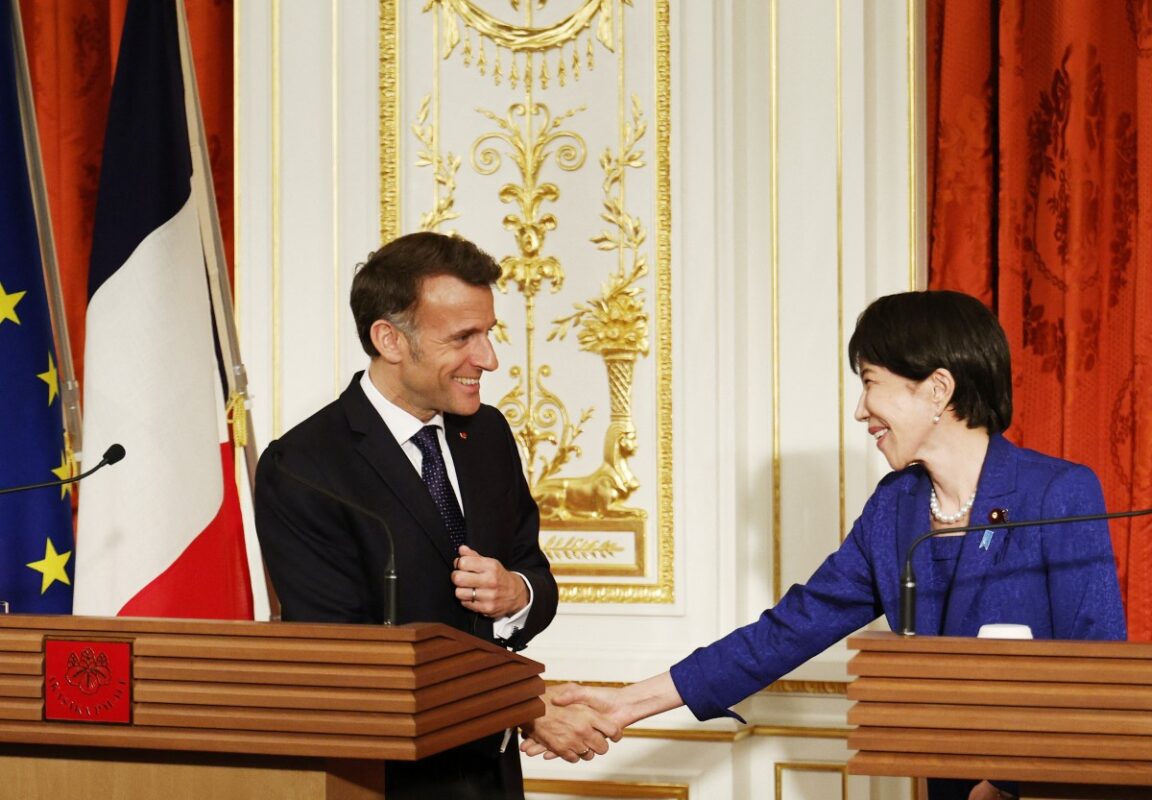
The visit of Emmanuel Macron to Japan marks a structural strengthening of Franco-Japanese nuclear cooperation, from the nuclear fuel cycle to advanced reactors.
Japan has long been a partner of France, with which it shares, among other objectives, the goal of closing the nuclear fuel cycle. This involves a strategy based on reprocessing and recycling, as well as the development of fast neutron reactors. French President Emmanuel Macron and Japanese Prime Minister Sanae Takaichi affirmed the importance of this partnership through a new joint declaration dedicated to nuclear energy, published on 1 April 2026. The sector constitutes one of the pillars of the roadmap for Franco-Japanese cooperation (2023–2027).
The focus is placed on six areas of cooperation: (1) the long-term and safe operation of nuclear reactors; (2) support for newcomer nuclear countries and the strengthening of supply chains; (3) enhanced cooperation in the field of nuclear fuel; (4) the promotion of safe and responsible decommissioning of nuclear facilities; (5) cooperation on next-generation advanced reactors; and finally, (6) the continuation of cooperation on fusion energy projects.
Fuel: a new contract for Orano
“The French President and the Japanese Prime Minister will strive to ensure the safe and long-term operation of facilities related to reprocessing, notably through the development of on-site human resources. Their cooperation will also promote bilateral demonstration studies on the reprocessing of mixed oxide spent fuel,” details the joint declaration, which also mentions strengthening supply chains, uranium production, increasing enrichment capacity, as well as MOX fuel fabrication.
On the occasion of the summit, Orano announced the signing of a contract for the reprocessing of 200 tonnes of fuel from the operator Kansai Electric Power Company. The Osaka-region utility operates 7 of the 14 units currently in operation in Japan. The Rokkasho reprocessing plant in Japan is expected to start up in 2027 and gradually reach its nominal production capacity. In this context, France remains an essential partner for Japanese utilities.
Supporting newcomer nuclear countries
The objective here is to support newcomer countries “in accordance with the Milestones Approach of the International Atomic Energy Agency (IAEA).” This support can take different forms, including technical and organisational assistance, as well as the supply of reactors. The declaration specifically mentions Europe and the Indo-Pacific as areas of activity.
Two weeks earlier, on 15 and 16 March 2026, Mitsubishi Electric, Holtec International and Hyundai Engineering & Construction also signed a memorandum of understanding (MoU) for the deployment of small modular reactors in Southeast Asia. A second MoU also brings together GE Vernova and Hitachi for the deployment of the BWRX-300 boiling water SMR in the same region.
Development of fast neutron reactors
France and Japan are two key players in the development of fast neutron reactors. France notably operated the Phénix reactor (1974–2010) and Superphénix (1985–1996), the most powerful sodium-cooled fast neutron reactor ever built. Japan operates the small Jōyō reactor (1977–2007), which is expected to restart in 2026, and Monju, which unfortunately operated very little due to technical issues. Both countries now share the objective of developing such reactors and have confirmed “their intention to make progress, through reciprocal cooperation, in the development of experimental sodium-cooled fast reactors by 2050.”
Decommissioning: a Japanese technocentre?
“The French President and the Japanese Prime Minister will develop their cooperation on the safe and responsible decommissioning of nuclear facilities, with particular attention to the efficient management and treatment of metallic waste,” explains the joint declaration. “They will promote, within their bilateral cooperation, the participation of civil society, notably through joint initiatives on the recycling and reuse of materials derived from radioactive waste and through the sharing of their expertise in public awareness. Joint initiatives are envisaged to explore common approaches to the management and treatment of metallic waste in Japan, particularly within the framework of the Reinan E Coast project between EDF and the Fukui Prefecture.” A project similar to the one developed in Fessenheim by EDF and its subsidiary Cyclife, while 24 Japanese reactors are scheduled for decommissioning. ■
By Gaïc Le Gros, journalist
Image: Japanese Prime Minister Sanae Takaichi and French President Emmanuel Macron during a press conference at Akasaka Palace, Tokyo, on 1 April 2026 – © Franck ROBICHON / POOL / AFP