
Nuclear Energy, Heatwaves and Air Conditioning in France: Moving Beyond Common Misconceptions

As heatwaves become more frequent, air conditioning is becoming an increasingly important use of electricity. In France, where electricity generation is largely low-carbon thanks to nuclear power, its impacts deserve to be examined beyond common misconceptions.
As the effects of climate change are already being felt across France, the need for adaptation has become more urgent than ever. The second heatwave of the year currently affecting the country has already had significant health consequences, with seven reported fatalities. While mitigating climate change remains the priority, adapting lifestyles and infrastructure is equally essential. In this context, air conditioning is no longer simply a matter of comfort but a necessity. Yet it remains surrounded by widespread misconceptions and continues to fuel political debate.
1. Moderate electricity consumption in France’s largely low-carbon power system
Contrary to some common assumptions, air conditioning represents a relatively modest share of household electricity consumption.
According to ADEME[1], a portable air conditioner consumes on average around 710 kWh per year. By comparison, this is equivalent to the annual electricity consumption of eight 10-watt LED bulbs operating continuously throughout the year. Air-to-air heat pumps, now the preferred solution for residential cooling in France, consume even less electricity, around 112 kWh per year[2]. “With this equipment, annual electricity consumption is no higher than that of a television,” EDF noted in a video published on LinkedIn.
This additional electricity demand occurs within the specific context of the French power system, where electricity generation is both abundant and overwhelmingly low-carbon, largely thanks to nuclear power. According to RTE, electricity generation reached a historic high of 521.1 TWh in 2025. This performance was driven primarily by the recovery of nuclear fleet availability, with nuclear generation reaching 373 TWh. Renewable energy sources also contributed to this strong performance. At the same time, national electricity consumption remained broadly stable at 451 TWh, increasing by only 0.4% compared with 2024.
As a result, greenhouse gas emissions associated with French electricity generation fell to their lowest level on record, at 10.9 MtCO₂e, while 95.2% of electricity generation came from low-carbon sources.
Air conditioning does increase electricity demand during the hottest days. In its 2025 Electricity Report[3], RTE noted that: “Electricity demand in European countries has historically been weather-sensitive, to varying degrees, due to electric heating in autumn and winter and air conditioning during summer.” In France, however, this additional demand occurs within a power system that is already largely decarbonised and benefits from substantial generating capacity.
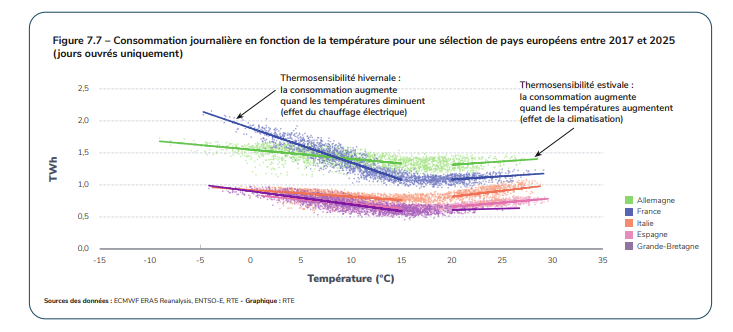
Figure 1: Winter and summer weather sensitivity of electricity demand in European countries (Source: RTE)
The tensions observed during summer evenings nevertheless illustrate the value of dispatchable generation. On June 22, as solar generation declined towards the end of the day, France exported large amounts of electricity to Germany while simultaneously dispatching its gas-fired power plants to balance the system. These episodes highlight the importance of having low-carbon dispatchable generation capable of taking over as solar generation declines (see box).
2. A tool for adapting to the health impacts of heatwaves
Beyond energy considerations, the primary issue surrounding air conditioning is public health. The World Health Organization estimates that between 2000 and 2019, approximately 489,000 heat-related deaths occurred each year worldwide, 36% of them in Europe.[4]
In France, the 2003 heatwave remains a tragic benchmark. According to Inserm, it resulted in approximately 15,000 excess deaths compared with the usual mortality observed during that period of the year. Dehydration, heatstroke and hyperthermia[5] were among the main identified causes.
The events of 2026 serve as a reminder that this threat remains very real. As the country experiences its second heatwave of the year, seven deaths have already been officially attributed to this episode.
The most vulnerable populations are the first to be affected: older adults, people with chronic illnesses, young children, and those living in poorly insulated homes. Yet the level of equipment remains relatively low. In France, between 18% and 26%[6] of homes are equipped with air conditioning. The situation is even more striking in facilities caring for vulnerable people: according to the figures cited by the author, 91.4% of nursing homes (EHPADs) are not air-conditioned.[7]
The health benefits of air conditioning are nevertheless well documented. A study published in The Lancet[8] estimates that air conditioning prevented approximately 195,000 heat-related deaths among people over the age of 65 worldwide in 2019.
3. A limited urban impact
Criticism of air conditioning often focuses on the heat released by outdoor units, which may contribute to intensifying urban heat islands.
France’s Minister for the Ecological Transition, Monique Barbut, has estimated that widespread deployment of air conditioning in Paris could increase ground-level temperatures by 2 to 3°C. Geographer Magali Reghezza-Zitt also points out that air conditioning can contribute to higher outdoor temperatures while increasing electricity demand.
The available scientific studies nevertheless qualify these scenarios.
In a study conducted by Vincent Viguié et al. in 2020,[9] researchers simulated the effects of widespread air conditioning during a heatwave comparable to that of 2003. In Paris,[10] the average increase in street-level temperatures would range between 0.25°C and 0.75°C at 4:00 a.m. after nine consecutive days of heatwave conditions.
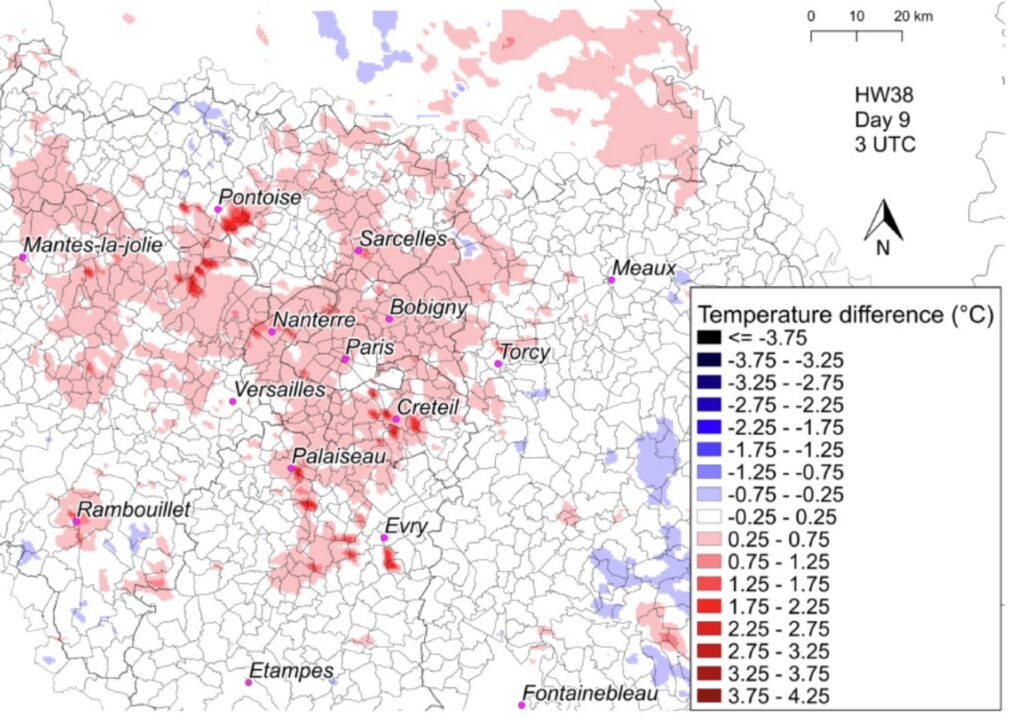
Figure 2: Effect of air conditioning on temperatures in the city of Paris (Source: Environmental Research Letters)
Comparable results have been observed in Japan, where air conditioning is widely used. One study estimates that its use contributed to an average increase in urban temperatures of approximately 0.046°C during the month of August between 2000 and 2010. This increase is estimated to have been associated with approximately 3% of heat-related deaths over the period.
At the same time, the widespread use of air conditioning is estimated to have reduced overall mortality during heatwaves by 36%.
Above all, a public health trade-off
Air conditioning is neither a miracle solution nor the sole response to climate change adaptation. Improving building insulation, expanding urban greenery, installing solar protection and adapting urban planning remain essential.
The available evidence nevertheless shows that, in a country such as France, where electricity is largely low-carbon, the energy and climate costs associated with air conditioning remain limited compared with its public health benefits. As heatwaves are expected to become more frequent and more intense, the issue therefore appears less to be a debate about electricity consumption than one of adaptation and the protection of the most vulnerable populations. ■
By Floriane Jacq (Sfen)
Image: © Nicolas Tucat / AFP
Box: During the summer, outside heatwave periods, electricity demand generally ranges between 35 and 50 GW. During periods of extreme heat, however, demand increases as air conditioning use becomes more widespread. On June 22, for example, electricity demand fluctuated between 36 and 57 GW.
On the supply side, nuclear generation is traditionally lower during the summer. At present, around 44 GW of nuclear generating capacity are available out of the country’s 63 GW of installed nuclear capacity. This reduction is mainly due to scheduled reactor maintenance outages. Wind generation is also almost non-existent because of the lack of wind.
During the day, between 9:00 a.m. and 6:00 p.m., the “solar bell” supplies a significant share of electricity demand. However, as photovoltaic generation declines at sunset, other generating sources must be brought online. Electricity demand currently peaks at around 7:00 p.m. Gas-fired power plants are therefore dispatched not only to meet domestic demand, but also to help supply neighbouring countries, particularly Germany.
[1] How to Choose an Air Conditioning System? | ADEME
[2] https://librairie.ademe.fr/batiment/8595-etude-sur-les-consommations-des-pac-air-air.html
[4] https://www.who.int/news-room/fact-sheets/detail/climate-change-heat-and-health
[5] Excess Mortality Associated with the August 2003 Heatwave · Inserm – Science for Health
[6] https://batizoom.ademe.fr/indicateurs/part-des-logements-climatises
[8] https://www.thelancet.com/article/S0140-6736(21)01787-6/fulltext
[9] Early adaptation to heat waves and future reduction of air-conditioning energy use in Paris
[10] Air conditioning is assumed to maintain an indoor temperature of 23°C in all buildings, based on an optimistic assumption regarding air-conditioner efficiency (coefficient of performance ranging from 12 to 15 depending on the building type), with the heat generated by the air-conditioning systems being released into the streets.