
Gironde wildfires: how are nuclear power plants protected?
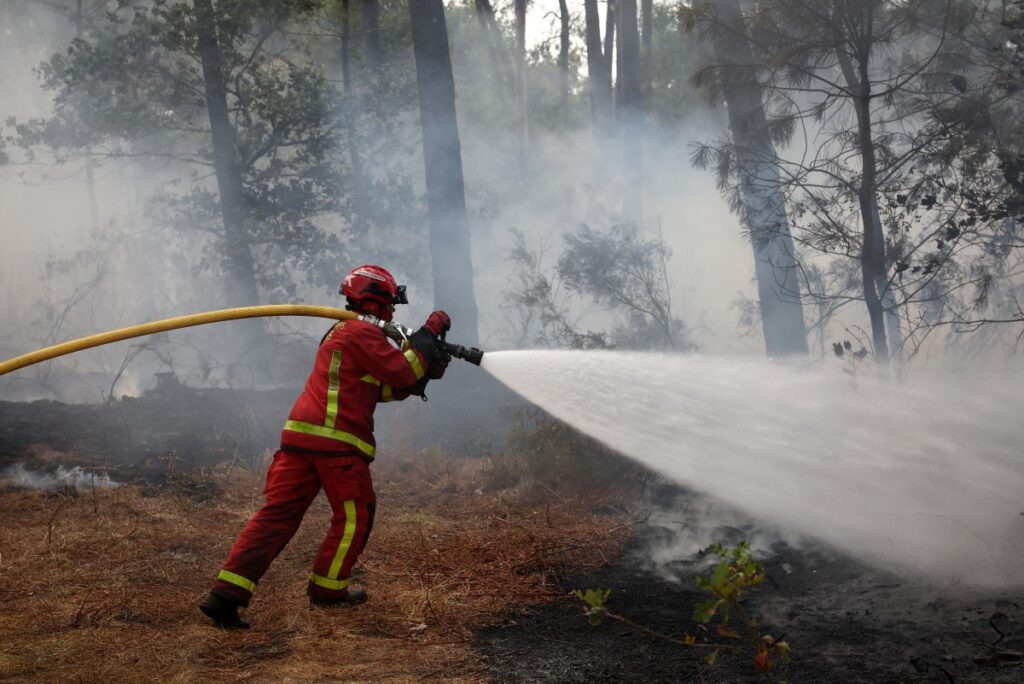
The fires currently affecting Gironde are raising legitimate questions about the ability of nuclear power plants, and the Blayais plant in particular, to withstand a forest or vegetation fire near their facilities.
In France, at the design stage, nuclear facilities undergo an assessment of their protection against risks known as “external hazards”: natural hazards, industrial hazards, aircraft crashes, etc. This assessment determines the protective measures—prevention and response—to be implemented at the facility.
Facilities designed to withstand forest fires
Protection against fires of external origin, particularly forest fires, is therefore an integral part of this approach. French nuclear power plants have consequently been designed to withstand this risk. In the event of a forest fire, thermal radiation constitutes the primary risk to facilities. Close to the fire, the heat may cause equipment to ignite or impair its operation.
Specific measures and regular assessment of facilities
The measures taken to protect against forest fires mainly include the establishment of safety zones around sites—through firebreaks, pruning, vegetation clearance, tree clearance, etc.—in order to keep the fire away from the facility and maintain the availability of power lines and access routes to the sites, including roads.
The plants are also subject to regular assessments in the area of protection against fire-related risks. On its website, the Nuclear Safety and Radiation Protection Authority (ASNR) states: “With regard to nuclear power plants, as part of the third ten-yearly inspections of EDF’s pressurised water reactors, the assessment of forest-fire-related risks did not identify any need for additional measures.”
Close coordination with government services
These measures are also supplemented by a rapid on-site response capability, with appropriate firefighting resources, in coordination with the local public authorities. EDF points out that “the plants maintain close cooperation with the departmental fire and rescue services (SDIS) to ensure effective coordination in managing fire risk. Since 2019, under a nationwide arrangement, a professional fire officer (OSPP) has been stationed at each nuclear power plant. Their role is to facilitate relations between the plant and the SDIS and to take part in staff training.”
No impact to date on the Blayais nuclear power plant
The Blayais site is home to the plant operated by EDF in the Gironde department, 50 km north of Bordeaux. This nuclear power plant comprises four 900 MWe pressurised water reactors. It is located on a large site on the banks of the Gironde estuary. Its immediate surroundings consist of marshland, which is not highly exposed to forest-fire risk, rather than a forested area.
On 27 July 2026, EDF stated that “the ongoing fire in Gironde is having no impact on the operation of the reactors at the Blayais nuclear power plant. […] At this stage, there are no difficulties in the area around the plant, which is 50 to 60 km away from the fire sites.” The latter are also located on the opposite bank of the estuary.
“The plants carry out maintenance around the facilities, including, in particular, vegetation clearance work,” the operator points out. On Wednesday 22 July 2026, “the Nuclear Safety Manager at the Blayais nuclear power plant, together with the site’s OSPP, carried out an in-depth inspection to confirm that vegetation clearance around the plant and the RTE substation was sufficient. The mowing was deemed sufficient by the OSPP, based on the distance from the nearest buildings or structures. The access routes dedicated to external emergency services are also secured.” ■
By Hélène Perrin, RGN journalist
Image: A firefighter from the Paris Fire Brigade sprays water on hotspots in Marcheprime, west of Bordeaux, on 26 July 2026 – @ ROMAIN PERROCHEAU / AFP